

The Record God Gave of His Son
40 Scriptural Revelations That Jesus the Christ Is
Eternal God Manifested in Human Flesh
______________________
Author: Wes W. Hazlett
Editor: Mischeal Steinert
BODYGUARD CHRISTIAN APOLOGETICS
Revelations Added Weekly
May this work serve as both a witness and a weapon—a witness to the truth of Christ’s deity, and a weapon against deception and error.
To Him give all the prophets witness... — Acts 10:43 Early in my study of the deity of Christ, I came across a small book that would leave a lifelong imprint in my spirit: Messiah as Seen in the Old Testament by V.L. Peterson and Earl Werner (F.C. Press, Minneapolis, 1961). It floored me. I was stunned by how beautifully interwoven the Messiah is throughout the 66 books of the Canon—Old and New Testaments alike. Through their faithful exposition, I saw the greatness of God in the Christ: the Word, the Son, the Lamb, the Prophet, the King, and the Lord God Almighty.
And in seeing Him, I saw the depth of God’s love for His creation and His longsuffering toward me, most wretched of men.
This present work, The Record That God Gave of His Son, is born from that awakening. It seeks to echo the witness of Peterson and Werner, extending their legacy by tracing the radiant thread of Christ from creation to crown.
preface
The revelation of Jesus Christ as the Son of God is the cornerstone of divine truth—a testimony not given by man, but by God Himself. From the earliest prophecies of the Old Testament to the climactic declarations of the New Testament, Scripture speaks with one voice: Jesus is Yahweh incarnate, the eternal Lord who creates, redeems, judges, and reigns. This work is born out of a deep conviction that the deity of Christ is not a matter of speculation or tradition, but of divine record. The Hebrew prophets foresaw Him, the apostles bore witness to Him, and the Spirit confirms Him. Every title, every prophecy, every revelation converges in Christ.
The purpose of this book is twofold:
• To demonstrate through Scripture—with careful attention to the original Hebrew and Greek roots—that Christ is fully God.
• To defend the faith—offering a clear, structured apologetic that leaves no room for doubt, showing that the promises of Yahweh are fulfilled in Jesus. This is not merely an academic exercise, but a call to worship. For if Christ is Yahweh incarnate, then He is worthy of all glory, honor, and praise. To deny His deity is to deny the very testimony of God; to confess Him as Lord is to embrace eternal life. As it is written:
“And this is the record, that God hath Given to us Eternal Life, and this Life is in His Son.” — 1 John 5:11
Introduction
The testimony of Scripture is not fragmented, nor is it divided between two testaments. From Genesis to Revelation, the Word of God speaks with one voice: Jesus Christ is Yahweh incarnate, the eternal Son revealed in flesh. The Old Testament conceals Him in prophecy, type, and shadow; the New Testament unveils Him in fulfillment, clarity, and glory. This work is built upon a simple but profound conviction: the original languages of Scripture—Hebrew, Aramaic, and Greek—bear witness to Christ’s deity. Each divine title, each prophetic utterance, each covenantal promise is rooted in words that carry eternal weight. By tracing these roots, we discover that the God of Israel and the Christ of the apostles are one and the same.
Methodology of This Work
• Apologetic Structure: Each section follows a uniform pattern—Old Testament foundation, New Testament fulfillment, linguistic analysis, theological implications, and a conclusive affirmation that Christ IS God.
Why This Approach Matters
• Many have attempted to separate Christ from Yahweh, claiming He is merely a prophet, a created being, or a lesser god. Yet the Scriptures leave no room for such error.
By examining the original language roots, we see that the very words used of Yahweh in the Old Testament are applied without hesitation to Christ in the New Testament. This is not coincidence, nor poetic flourish—it is divine revelation.
The Mission of This Work
This book is to affirm the divine record through a faithful exegesis of Holy Scripture by allowing the text of Scripture to speak for the text of Scripture.
• Christ is the Alpha and Omega.
• Christ is the Judge Himself.
• Christ is the Lamb enthroned forever.
• Christ is the Holy One of God.
• Christ IS God.
As the apostle John declared:
“And this is the record, that God hath given to us eternal life, and this life is in His Son.” — 1 John 5:11 This introduction sets the stage for the chapters that follow, where each divine title and prophecy will be examined in detail, Hebrew and Greek roots will be integrated, and the conclusion will be inescapable: Jesus Christ is Yahweh incarnate, the eternal God revealed.
Methodology Note
The purpose of this work is not merely to quote Scripture, but to demonstrate the unity of God’s revelation through careful attention to the original languages. The Hebrew and Greek roots are not incidental; they are the Spirit-breathed foundation upon which the testimony of Christ’s deity rests.
Why Hebrew and Greek Roots Matter
• Hebrew (Old Testament) — The divine names, titles, and attributes applied exclusively to Yahweh (qadosh, “Holy One”; ri’shon/acharon, “First and Last”; zeroa, “Arm”; shaphat, “Judge”) establish His unique identity as the one true God.
• Greek (New Testament) — These same titles and attributes are applied directly to Jesus (hagios, “Holy One”; protos/eschatos, “First and Last”; brachiōn, “Arm”; krinō, “Judge”), showing that the apostles and Christ Himself claimed the prerogatives of Yahweh.
• Continuity of Revelation — By tracing the roots across both testaments, the conclusion is inescapable: the God of Israel and the Christ of the apostles are one and the same.
Theological Significance
• Essence vs. Persons — The analysis of roots clarifies that Yahweh’s essence (the “what” God is) remains indivisible, while His revelation in Father, Son, and Spirit (the “who” God is) is distinct yet united.
• Apologetic Force — False teachings collapse when confronted with the linguistic precision of Scripture. If Yahweh alone is Savior, and Christ is Savior, then Christ is Yahweh. If Yahweh alone is Judge, and Christ is Judge, then Christ is Yahweh.
• Witness of the Record — This method ensures that the testimony is not based on tradition or conjecture, but on the inspired words themselves.
The Godhead: Our Confession of One Eternal
Essence
Why Wes Hazlett and Bodyguard Christian Apologetics never use the word 'Trinity'.
We affirm the eternal deity of the Father, the Son, and the Holy Spirit—one God in three persons. While the word Trinity has been used historically to defend orthodoxy, it is not a biblical term. Scripture itself uses the word Godhead (Acts 17:29; Romans 1:20; Colossians 2:9), and we prefer to anchor our confession in inspired language.
The term 'Trinity' has sometimes caused confusion, and counterfeit sects misuse it to suggest Christianity borrowed from Roman Catholic tradition. By using the biblical word Godhead, we emphasize unity of essence, clarity of doctrine, and fidelity to the Word of God.
Our faith remains fully committed to Holy Scripture, which reveals the Father, the Son, and the Holy Spirit to be fully God—three distinct personages, yet one God in spirit, substance, and essence. Bodyguard Christian Apologetics maintains the biblical terminology of the Godhead, affirming eternal unity and divine sovereignty.
Bodyguard Christian Apologetics reveals through Holy Scripture that the Old and New Testament reveals that God reveals Himself through the Father, the Son, and the Holy Spirit.
The Record God Gave of His Son presents forty revelations declaring that Jesus the Christ is Almighty God manifested in human flesh—born of a virgin, without sin, yet in all points tempted as we are; the Man of Sorrows, acquainted with grief, who endured suffering even unto the death of the cross.
Please see our addendum guide 500: 500 English Bible Versions and John 1:1 for additional context. (Bible Versions now at 700)
Table of Contents
-
Dedication
-
Preface
-
Introduction
-
Reader’s Guide
-
Methodology Note
-
Special Notation (All Scripture from KJV; full texts in Appendix F)
-
Sections currently being added. Please see our weekly series on the Record via X.
TOC note: Full Table of Contents to be included in final version of PDF to be published online in early 2026.
Part I: Titles and Identity
-
The First and the Last — Yahweh’s eternal titles are claimed directly by Christ.
-
The Alpha and the Omega — The beginning and end of all things converge in Jesus.
-
Behold, I Come Quickly — Christ fulfills Yahweh’s promise of imminent judgment and reward.
-
The Creator — The Son is revealed as the Maker of all things.
-
The Savior — Salvation belongs to Yahweh alone —yet is fulfilled in Christ. R5 APPENDIX
-
Worship Belongs to God Alone — Christ receives worship reserved only for God. R6 APPENDIX
-
Trust God — Trust in YHWH - God directs Mankind to Trust in Christ. R7 APPENDIX
-
None Can Deliver Out of My Hand — Christ holds divine authority over life and destiny.
-
The Ancient of Days and the Son of Man — Eternal Yahweh and the Messianic Son are united in Christ.
-
God Is Our Life — Christ embodies the eternal life Yahweh gives.
Part II: Prophetic Fulfillment in Christ
11. The Mighty God — Isaiah’s prophecy of the divine child is fulfilled in Jesus. COMING LATE FALL OF 2026
12. God With Us — Immanuel is revealed as Christ dwelling among His people.
13. The Eternal One — Jesus declares Himself the timeless “I AM.”
14. Whom Makest Thou Thyself? — Christ’s identity as Yahweh provokes confrontation.
15. When Did Abraham See Christ? — Jesus reveals His preexistence before Abraham.
16. God Will Provide Himself a Lamb — The Lamb of God fulfills Yahweh’s promise of sacrifice.
17. Reconciled to God Through Christ — Atonement is accomplished by the Son’s blood. R17 APPENDIX
18. A Highway for Our God — Christ fulfills Isaiah’s prophecy of the way prepared for Yahweh.
19. I Will Give Thee Rest — Jesus offers the divine rest promised by Yahweh. R19 APPENDIX
20. Arise, and Christ Shall Give Thee Light — Christ is the light that fulfills God’s promise.
Part III: Redemption and Eternal Reign
21. As Many as I Love, I Rebuke — Christ exercises divine authority in discipline and love.
22. The Marriage Supper of the Lamb — Jesus is the Lamb who hosts the eternal feast.
23. God Is the Light of Jerusalem — Christ is the everlasting light of the New Jerusalem.
24. Vengeance Is Mine — Divine vengeance is executed by Christ.
25. They Shall Look Upon Me Whom They Have Pierced — Fulfilled in Christ. R25 APPENDIX
26. Valued at 30 Pieces of Silver — Christ fulfills Zechariah’s prophecy of betrayal.
27. Whoever Calls Upon the Name of the Lord — Salvation through Yahweh’s name is fulfilled in Christ.
28. Every Knee Shall Bow, Every Tongue Confess — Universal worship of Yahweh is directed to Jesus.
29. The Tree of Life — Christ restores access to the eternal tree of life.
30. The Song of the Lamb — The Redeemed Sing to the Lamb the Worship That Belongs Only to the Lord God Almighty
31. Serve God — Service to Yahweh is rendered to Christ.
32. The Lamb of God — Jesus is the sacrificial Lamb who takes away sin.
33. “But Unto the Son He Saith…” — The Throne of Christ — The Father declares the Son’s eternal throne.
34. “My Lord and My God” — Thomas’ Confession — Christ is confessed directly as God.
35. God Is Judge Himself — Jesus is revealed as the Judge of all.
36. The Wrath of God — Christ executes divine wrath upon the ungodly.
37. Worship at His Footstool — Christ receives worship at the throne of Yahweh.
38. The Holy One of God — Jesus is confessed as the Holy One, a title reserved for Yahweh.
39. The Arm of the Lord — Christ is the revealed strength and power of Yahweh. R39 APPENDIX
40. Thou Shalt Not Tempt the Lord Thy God — Yahweh's prohibition revealed in Christ's rebuke of Satan.
APPENDIX SECTIONS WILL BE NOTED IN EACH CORRELATING REVELATION

APPENDIX to R5: The Name Jesus: YHWH's Declaration of Salvation (Yēshua‘: YHWH Saves)
APPENDIX to R6: Tell No Man: God Sets the Times and Seasons
APPENDIX to R7: Gentiles, Trust, and the Messiah — A Prophetic-Linguistic Analysis
APPENDIX to R17: The Salvific Hinge— Why the Salvation of Mankind Needed the Messiah to be Fully God
APPENDIX TO R19: The Gospel of God revealed in the names of Genesis
APPENDIX TO R25: The Pierced Yahweh
APPENDIX To R39: Christ Revealed as the Arm of the Lord: The Manifest Power of YHWH
The Record God Gave of His Son
40 Revelations of the Deity of Jesus Christ
_________________________
Weekly sections are currently being added.


The First &
the last
“I the LORD, the first, and with the last; I am he.”
FIRST Revelation
R1. The First and the Last
Yahweh’s eternal titles are claimed directly by Christ
1. Old Testament Foundation
“Who hath wrought and done it, calling the generations from the beginning? I the LORD, the first, and with the last; I am he.”
—Isaiah 41:4
“Thus saith the LORD the King of Israel, and his redeemer the LORD of hosts; I am the first, and I am the last; and beside me there is no God.”
—Isaiah 44:6
“Hearken unto me, O Jacob and Israel, my called; I am he; I am the first, I also am the last.”
—Isaiah 48:12
Key Verses Isaiah 44:6 — “Thus saith the LORD (YHWH), the King of Israel, and his redeemer the LORD of hosts; I am the first, and I am the last; and beside Me there is no God.”
Apologetic Point: In Hebrew, ri’shon (רִאשׁוֹן, “first”) and acharon (אַחֲרוֹן, “last”) emphasize Yahweh’s eternal supremacy and exclusivity.
2. Christ’s Declaration in Revelation
“Fear not; I am the first and the last: I am He that liveth, and was dead; and behold, I am alive for evermore.”
—Revelation 1:17–18
“These things saith the first and the last, which was dead, and is alive.”
—Revelation 2:8
Key Verse Revelation 1:17 — “Fear not; I am the first and the last: I am He that liveth, and was dead; and behold, I am alive for evermore.”
Apologetic Point: In Greek, ho protos kai ho eschatos (ὁ πρῶτος καὶ ὁ ἔσχατος, “the First and the Last”) is applied directly to Christ, showing He claims Yahweh’s eternal title.
3. Analysis of the Title
-
Hebrew Root: ri’shon (first), acharon (last) — eternal sovereignty.
-
Greek Root: protos (πρῶτος, “first”), eschatos (ἔσχατος, “last”) — absolute beginning and end.
Apologetic Point: Identical titles in Hebrew and Greek demonstrate continuity. The One who speaks in Isaiah (YHWH) is the same One revealed in Revelation (Christ).
4. Theological Implications
-
Eternal Sovereignty: Christ shares Yahweh’s timeless identity.
-
Exclusivity: No other being can claim this title.
-
Unity of Revelation: OT and NT converge in Christ’s declaration.
5. Conclusive Statement
In Hebrew, YHWH declares Himself “the First and the Last.” In Greek, Christ declares Himself “ho protos kai ho eschatos.” Both titles signify eternal sovereignty and exclusivity.
Overall Conclusion: The Hebrew YHWH and the Greek ho protos kai ho eschatos converge in Christ. The First and the Last is Jesus.
The Alpha &
The Omega
Second Revelation
“I am Alpha and Omega...What thou seest, write in a book,.”
R2. The Alpha and the Omega
Christ declares Himself the Alpha and the Omega
— eternal God revealed
1. Divine Foundation
“I am Alpha and Omega, the beginning and the ending, saith the Lord, which is, and which was, and which is to come, the Almighty.”
—Revelation 1:8
“And he said unto me, It is done. I am Alpha and Omega, the beginning and the end. I will give unto him that is athirst of the fountain of the water of life freely. He that overcometh shall inherit all things; and I will be his God, and he shall be my son.”
—Revelation 21:6–7
Key Verse Revelation 1:8 — “I am Alpha and Omega, the beginning and the ending … the Almighty.”
Apologetic Point: Alpha (Α) and Omega (Ω), the first and last letters of the Greek alphabet, symbolize totality and eternal completeness. This title belongs exclusively to God.
2. Christ’s Own Declaration
“Behold, I come quickly … I am Alpha and Omega, the beginning and the end, the first and the last.”
—Revelation 22:12–13
“I am Alpha and Omega, the first and the last: and, What thou seest, write in a book.”
—Revelation 1:10–11
Key Verses Revelation 22:13 — “I am Alpha and Omega, the beginning and the end, the first and the last.”
Apologetic Point: Christ directly applies the divine title Alpha and Omega to Himself, uniting it with ho protos kai ho eschatos.
3. Analysis of the Title
-
Greek Roots:
-
Alpha (ἄλφα) — first letter, symbolizing origin.
-
Omega (ὦμέγα) — last letter, symbolizing consummation.
-
Apologetic Point: The same eternal designation given to God in Revelation 1:8 is claimed by Christ in Revelation 22:13. This is direct identification with the Almighty.
4. Theological Implications
-
Eternal Existence: Christ is not created; He is the beginning and the end.
-
Supreme Authority: Creation, judgment, and redemption are encompassed in this title.
-
Unity with the Father: Both Father and Son bear the same eternal designation, affirming shared divine essence.
5. Conclusive Statement
Alpha and Omega is a divine title reserved for God. Christ claims this title for Himself in Revelation. The Greek Alpha and Omega unite with ho protos kai ho eschatos to reveal His eternal sovereignty.
Overall Conclusion: The eternal titles Alpha and Omega belong to Christ. He is the beginning and the end, the Almighty.

Behold,
I Come Quickly
"...Be strong, fear not: behold, your God will come with vengeance..."
Third Revelation
R3. Behold, I Come Quickly
Christ fulfills Yahweh’s promise of judgment and reward.
______________________
1. Old Testament Foundation: Yahweh’s Sovereign Judgment
“Behold, the Lord GOD will come with strong hand, and his arm shall rule for him: behold, his reward is with him, and his work before him.”
—Isaiah 40:10
“Behold, the LORD hath proclaimed unto the end of the world, Say ye to the daughter of Zion, Behold, thy salvation cometh; behold, his reward is with him, and his work before him.”
—Isaiah 62:11
-
Connection: Nearly identical to Isaiah 40:10, this verse ties Yahweh’s coming with salvation, reward, and recompense — language Christ echoes in Revelation 22:12.
“Say to them that are of a fearful heart, Be strong, fear not: behold, your God will come with vengeance, even God with a recompence; he will come and save you.”
—Isaiah 35:4
“Behold, I will send my messenger, and he shall prepare the way before me: and the Lord, whom ye seek, shall suddenly come to his temple, even the messenger of the covenant, whom ye delight in: behold, he shall come, saith the LORD of hosts.”
—Malachi 3:1
-
Connection: Yahweh Himself promises to come suddenly to His temple. The New Testament identifies this with Christ’s arrival, tying divine presence to Jesus.
Key Verses Isaiah 40:10 — Behold, the Lord GOD (Adonai YHWH) will come with strong hand, and His arm shall rule for Him.
Apologetic Point: In Hebrew, Adonai YHWH (אֲדֹנָי יְהוָה) emphasizes the Lord God’s sovereign arrival in judgment and reward. The phrase “behold, He comes” is tied exclusively to divine authority, announcing Yahweh's urgent intervention.
2. New Testament Revelation:
“Behold, I come quickly: hold that fast which thou hast, that no man take thy crown.”
—Revelation 3:11
“Behold, I come quickly; and My reward is with Me, to give every man according as his work shall be. I am Alpha and Omega, the beginning and the end, the first and the last.”
—Revelation 22:12–13
“He which testifieth these things saith, Surely I come quickly. Amen. Even so, come, Lord Jesus.”
—Revelation 22:20
Key Verses Revelation 22:12; 3:11 — “Behold, I come quickly: hold fast that which thou hast, that no man take thy crown.”
Apologetic Point In Greek, erchomai tachy (ἔρχομαι ταχύ, “I come quickly”) is spoken directly by Christ. He links this to eternal divine titles like “Alpha and Omega” and ho prōtos kai ho eschatos (the first and the last), affirming His shared identity with Yahweh.
3. Analysis of the Phrase
Greek Root: Tachy (ταχύ) means “swiftly, without delay,” highlighting certainty and divine urgency.
Hebrew Parallel: Old Testament prophets use hinneh (הִנֵּה, “behold”) to proclaim Yahweh's coming in judgment.
Apologetic Point: The prophetic formula (hinneh in Hebrew / erchomai tachy in Greek) is identical when applied to Christ, proving He is the same Lord who executes judgment.
4. Theological Implications
Judgment Authority: Christ wields the “sword of His mouth” (Revelation 2:16), echoing Yahweh’s authority in Isaiah 11:4.
Reward Authority: Christ promises crowns and eternal inheritance—a role reserved solely for God.
Unity of Titles: By merging “I come quickly” with “Alpha and Omega,” Christ positions Himself as the eternal Judge and Redeemer, underscoring Godhead unity without conflating persons.
5. Conclusive Statement
In Hebrew, Adonai YHWH declares His coming in judgment and reward.
In Greek, Christ declares erchomai tachy with the authority of Alpha and Omega.
The prophetic “behold” (hinneh) formula applies equally to Yahweh and Christ.
Christ’s authority over judgment and reward mirrors Yahweh’s exactly.
**********************
Overall Conclusion The Hebrew Adonai YHWH and Greek erchomai tachy converge in Christ. The One who comes quickly is the Almighty.
_________________________________________________

The Creator
"And, Thou, Lord, in the beginning hast laid the foundation of the earth..."
FOURTH Revelation
R4. The Creator
Christ revealed as sovereign Creator of all things
1. Old Testament Foundation: Yahweh Alone Creates
“In the beginning God created the heaven and the earth.”
—Genesis 1:1
“And the LORD God formed man of the dust of the ground, and breathed into his nostrils the breath of life; and man became a living soul.”
—Genesis 2:7
“Hast thou not known? hast thou not heard, that the everlasting God, the LORD, the Creator of the ends of the earth, fainteth not, neither is weary? there is no searching of his understanding.”
—Isaiah 40:28
“By the word of the LORD were the heavens made; and all the host of them by the breath of his mouth…
—Psalm 33:6
"For he spake, and it was done; he commanded, and it stood fast.”
—Psalm 33:9
“Of old hast thou laid the foundation of the earth: and the heavens are the work of thy hands.”
—Psalm 102:25
“Thus saith God the LORD, he that created the heavens, and stretched them out; he that spread forth the earth, and that which cometh out of it; he that giveth breath unto the people upon it, and spirit to them that walk therein.”
—Isaiah 42:5
Key Verse Genesis 1:1 — “In the beginning God (Elohim) created (bara) the heaven and the earth.”
Apologetic Point: In Hebrew, bara (בָּרָא, “to create”) and bore’ (בּוֹרֵא, “Creator”) are used exclusively of Yahweh. Creation is His sole prerogative, never shared with another. In Hebrew, bara (בָּרָא, “to create ex nihilo”) is used exclusively of Yahweh’s sovereign act—no creature participates. Bore’ (בּוֹרֵא, “the Creator”) is His unique title. Yāsad (יָסַד) the foundations, ma‘ăśeh (מַעֲשֶׂה) of His hands, yāṣar (יָצַר) man from dust—all declare Yahweh alone brings existence from non-existence, forms life, and sustains it by His word and breath.
2. New Testament Revelation: Christ as Creator
“In the beginning was the Word, and the Word was with God, and the Word was God. The same was in the beginning with God. All things were made by him; and without him was not any thing made that was made.”
—John 1:1–3
“For by him were all things created, that are in heaven, and that are in earth, visible and invisible, whether they be thrones, or dominions, or principalities, or powers: all things were created by him, and for him: And he is before all things, and by him all things consist.”
—Colossians 1:16–17
“Hath in these last days spoken unto us by his Son, whom he hath appointed heir of all things, by whom also he made the worlds; Who being the brightness of his glory, and the express image of his person, and upholding all things by the word of his power, when he had by himself purged our sins, sat down on the right hand of the Majesty on high.”
—Hebrews 1:2–3
Key Verse Colossians 1:16 — “For by Him were all things created … all things were created by Him, and for Him.”
Apologetic Point In Greek, ktizō (κτίζω, “to create”) is applied directly to Christ. The same creative authority attributed to Yahweh in Hebrew is revealed in Jesus in Greek.
3. Analysis of the Title “Creator”
-
Hebrew Roots:
-
bara (בָּרָא) — “to create from nothing,” used only of God’s acts.
-
bore’ (בּוֹרֵא) — “Creator,” title of Yahweh (Isaiah 40:28; 42:5).
-
yatsar (יָצַר) — “to form,” used in Genesis 2:7 for God shaping man.
-
-
Greek Roots:
-
ktizō (κτίζω) — “to create, bring into existence,” applied to Christ (Colossians 1:16).
-
ktisis (κτίσις) — “creation,” the result of divine creative action (Romans 8:22; 2 Corinthians 5:17).
-
Apologetic Point: The exclusivity of bara and ktizō shows Christ is not a secondary agent but the eternal Creator Himself. The NT writers deliberately use the same creative verbs reserved for Yahweh to describe Christ’s work.
Apologetic Point: The identical exclusivity of bara and ktizō shows Christ is not a secondary agent but the eternal Creator Himself.
In Hebrew, Yahweh (יְהוָה) is the sole Creator: yāsad (יָסַד, “laid the foundation”) the earth, and the heavens are ma‘ăśeh (מַעֲשֶׂה, “the work”) of His hands. Additionally, yāṣar (יָצַר, “formed”) man from the dust—prerogatives of divine power alone. No creature shares in unoriginated creation (Isa 44:24: “I am the LORD that maketh all things... alone”).
New Testament Revelation:
The Son Is the Creator Applied Directly to Christ
Hebrews 1:10 — “And, Thou, Lord, in the beginning hast laid the foundation of the earth; and the heavens are the works of thine hands.”John 1:1–3, 14 — “In the beginning was the Word... All things were made by him; and without him was not any thing made that was made... And the Word was made flesh, and dwelt among us.”
Apologetic Hammer: The Father addresses the Son as “Lord” (κύριε), quoting Psalm 102 directly: themelioō (θεμελιόω, “laid the foundation”) the earth, and the heavens are ergon (ἔργον, “the works”) of His hands.
The Logos (λόγος, “Word”) who became sarx (σάρξ, “flesh”) is the Creator through whom all things were made—identifying Jesus as the Yahweh who formed man.
-
Analysis of the Titles and Verbs
Hebrew Roots:
-
Yāsad (יָסַד) — to found, establish the foundations.
-
Ma‘ăśeh (מַעֲשֶׂה) — deeds, works of creation.
-
Yāṣar (יָצַר) — to form, shape as a potter.
Greek Roots:
-
Themelioō (θεμελιόω) — to lay the foundation (exact LXX rendering of yāsad).
-
Ergon (ἔργον) — works, deeds (precise equivalent of ma‘ăśeh).
-
Logos (λόγος) — the divine expression through which creation occurs; ginomai sarx (γίνομαι σάρξ) — became flesh.
4. Theological Implications
-
Unity of Identity: Yahweh is declared the sole Creator in the OT; Christ is declared the sole Creator in the NT.
-
Sustainer of All: Colossians 1:17 affirms Christ holds all things together (synestēken).
-
Divine Authority: Creation, preservation, and sovereignty belong to Christ, proving His full deity.
The Septuagint (LXX) renders Psalm 102 with themelioō and ergon—the identical terms quoted in Hebrews and applied to the Son. John echoes Genesis (“In the beginning”) while declaring the Logos as Creator who tabernacled in flesh.
5. Conclusive Statement
In Hebrew, YHWH alone creates (bara). In Greek, Christ creates (ktizō). Both verbs signify divine creation from nothing, exclusive to God. Christ is revealed as the eternal Creator and Sustainer.
Overall Conclusion:
In the beginning, the voice of Yahweh spoke, “Let there be...” and bara exploded into existence—heavens stretched, earth founded, man formed and breathed upon by the breath of the Almighty.
That same eternal Word, by whom all things were spoken into being, became flesh and tabernacled among us. The hands that laid the foundations of the earth were pierced; the breath that gave life to Adam was yielded up on the cross; the power that upholds the universe by His word purged our sins by Himself. The Father looks upon the Son and declares: “Thou, Lord, hast laid the foundation of the earth; and the heavens are the works of Thine hands.” The Hebrew bara, yāsad, yāṣar, and ma‘ăśeh thunder forth in unbreakable harmony with the Greek ktizō, themelioō, ergon, and logos—converging in one glorious Person: Jesus Christ. Yahweh alone creates ex nihilo, forms, and sustains.
The Son is declared the sole Creator and Sustainer—before all things, through all things, for all things. Therefore, the Creator who spoke the worlds into existence is none other than the crucified and risen Lord Jesus Christ. Christ IS Yahweh, the everlasting Creator, who became flesh to redeem His creation, and who now upholds all things by the word of His power as He sits enthroned at the right hand of the Majesty on high. Christ IS Creator.
_________________________________________________

The Savior
Fifth Revelation
“I, even I, am the LORD; and beside me there is no saviour.”
R5. The Savior
“Thou shalt call his name JESUS: for he shall save his people from their sins.” —Matthew 1:21
Only YHWH can Save from Sin (Isaiah 43:11)
1. Old Testament Foundation: Yahweh Alone Is Savior
“I, even I, am the LORD; and beside me there is no saviour.”
—Isaiah 43:11
21 Tell ye, and bring them near; yea, let them take counsel together: who hath declared this from ancient time? who hath told it from that time? have not I the Lord? and there is no God else beside me; a just God and a Saviour; there is none beside me.
22 Look unto me, and be ye saved, all the ends of the earth: for I am God, and there is none else."
—Isaiah 45:21–22
“Yet I am the LORD thy God from the land of Egypt, and thou shalt know no god but me: for there is no saviour beside me.”
—Hosea 13:4
Key Verse:
Isaiah 43:11: “I, even I, am the LORD (YHWH); and beside Me there is no saviour (mōshia‘).”
Apologetic Point:
In Hebrew, yāsha‘ (יָשַׁע, “to save, deliver”) and mōshia‘ (מוֹשִׁיעַ, “savior”) are used exclusively of Yahweh’s sovereign acts of deliverance. No creature, angel, or intermediary shares this prerogative—salvation belongs to YHWH alone.
2. New Testament Revelation: Christ as Savior
“For unto you is born this day in the city of David a Saviour, which is Christ the Lord.”
—Luke 2:11
“God sent not his Son into the world to condemn the world; but that the world through him might be saved.”
—John 3:17
“The Son of man is come to seek and to save that which was lost.”
—Luke 19:10
“Looking for that blessed hope, and the glorious appearing of the great God and our Saviour Jesus Christ.”
—Titus 2:13
Key Verse:
Titus 2:13: “The great God and our Saviour (sōtēr) Jesus Christ.”
Apologetic Point:
In Greek, sōtēr (σωτήρ, “Savior”) is applied directly and exclusively to Christ, echoing the absolute language reserved for YHWH in the Old Testament.
3. Analysis of the Title “Savior”
Hebrew Roots:
-
yāsha‘ (יָשַׁע) — to deliver, rescue, save; divine prerogative alone.
-
mōshia‘ (מוֹשִׁיעַ) — Savior; unique title of YHWH.
Greek Roots:
-
sōtēr (σωτήρ) — Savior, deliverer; applied to Christ without qualification.
-
sōzō (σῴζω) — to save; used of Christ’s mission (Luke 19:10).
Apologetic Point:
The identical exclusivity of yāsha‘/mōshia‘ in Hebrew and sōtēr in Greek demonstrates deliberate continuity. The New Testament writers ascribe the same absolute saving authority—reserved solely for Yahweh—to Jesus Christ.
4. Theological Implications
Prophetic Fulfillment:
The promised Seed of Genesis 3:15 crushes the serpent and reverses the curse—Christ Himself accomplishes the victory.
Divine Mission: Jesus declares His purpose: to seek and save the lost (Luke 19:10), fulfilling Yahweh’s exclusive claim.
Unity of Identity: Salvation belongs to YHWH alone in the Old Testament; the New Testament reveals that salvation is found only in Jesus (Acts 4:12). This is not delegation but direct identification—Christ is not a secondary agent but Yahweh incarnate executing personal redemption.
5. Conclusive Statement
In Hebrew, YHWH alone is Savior (yāsha‘, mōshia‘). In Greek, Christ is Savior (sōtēr). Both titles are exclusive to God. The Savior promised is the Savior provided—Yahweh in flesh.
Overall Conclusion
The voice that thundered from Sinai, “Beside Me there is no saviour,” is the same voice that cried from the manger, “Unto you is born… a Saviour, which is Christ the Lord.” The God who declared, “Look unto Me, and be ye saved, all the ends of the earth,” is the same God who stretched out His hands on the cross, drawing all men unto Himself. The Hebrew yāsha‘ and mōshia‘ resound in perfect harmony with the Greek sōtēr and sōzō—converging in one glorious Person: Jesus Christ.Yahweh alone saves—no rival, no delegate, no intermediary.
Yet the New Testament proclaims salvation in none other than Jesus.
Therefore, the Savior who sought and saved the lost is none other than the eternal YHWH who became flesh to redeem His own. Christ IS Yahweh, the only Savior, who laid down His life for the sheep and took it up again—now exalted as the great God and our Savior, forever worthy of all praise.
_____________________________________________________________
Worship Belongs
TO God Alone
"Thou shalt have none other gods before Me…"
Sixth Revelation
R6. WORSHIP BELONGS TO GOD
The Old Testament establishes an inviolable law:
worship belongs to YHWH alone.
1. Old Testament Foundation: Worship Is Reserved for YHWH Alone
"1 And God spake all these words, saying, 2 I am the LORD thy God, which have brought thee out of the land of Egypt, out of the house of bondage. 3 Thou shalt have no other gods before me. 4 Thou shalt not make unto thee any graven image, or any likeness of any thing that is in heaven above, or that is in the earth beneath, or that is in the water under the earth: 5 Thou shalt not bow down thyself to them, nor serve them: for I the LORD thy God am a jealous God, visiting the iniquity of the fathers upon the children unto the third and fourth generation of them that hate me; 6 And shewing mercy unto thousands of them that love me, and keep my commandments."
—Exodus 20:1–6
“For thou shalt worship no other god: for the LORD, whose name is Jealous, is a jealous God.”
—Exodus 34:14
“Thou shalt fear the LORD thy God, and serve him… Him shalt thou worship.”
—Deuteronomy 6:13; 10:20
“I am the LORD: that is my name: and my glory will I not give to another.”
—Isaiah 42:8
Key Verse — Exodus 34:14
“For thou shalt worship no other god: for the LORD, whose name is Jealous, is a jealous God.”
Apologetic Point:
When Yahweh calls for worship, the Hebrew term shachah—“to bow down, prostrate, worship”—is used in a covenantal and religious sense, reserved exclusively for Himself. Any redirection of shachah toward another object—whether a graven image, a false god, or a creature—is not merely a lesser honor but constitutes idolatry, provoking immediate judgment, as in Israel’s bowing before the golden calf or Nebuchadnezzar’s demand for worship. Within Israel’s covenant framework, worship is not simply an action; it is a declaration of deity. Shachah defines the boundary between Creator and creature, and Yahweh alone claims and receives it.
2. New Testament Revelation: Christ Receives Worship Reserved for God Alone
"8 And he sent them to Bethlehem, and said, Go and search diligently for the young child; and when ye have found him, bring me word again, that I may come and worship him also. 9 When they had heard the king, they departed; and, lo, the star, which they saw in the east, went before them, till it came and stood over where the young child was. 10 When they saw the star, they rejoiced with exceeding great joy. 11 And when they were come into the house, they saw the young child with Mary his mother, and fell down, and worshipped him: and when they had opened their treasures, they presented unto him gifts; gold, and frankincense, and myrrh. 12 And being warned of God in a dream that they should not return to Herod, they departed into their own country another way."
—Matthew 2:8-12
“Then they that were in the ship came and worshipped him, saying, Of a truth thou art the Son of God.”
—Matthew 14:33
“He said, Lord, I believe. And he worshipped him.”
—John 9:38
—Hebrews 1:6
“And every creature… said, Blessing, and honour, and glory… be unto him that sitteth upon the throne, and unto the Lamb.”
—Revelation 5:13–14
Key Verses: Matthew 2:8–12; 14:33; John 9:38; Hebrews 1:6; Revelation 5:13–14
Apologetic Point:
The Greek proskuneō—“to bow down, prostrate, worship”—is the Septuagint equivalent of shachah. When Christ is worshiped, proskuneō is used in a covenantal and religious sense, consistent with the Old Testament pattern. Unlike angels, apostles, or Herod—who refuse or are forbidden to receive worship—Christ receives it repeatedly: from the Magi, His disciples, the healed blind man, Thomas, and by command from God, the angels themselves (Hebrews 1:6). Worship is not a mere gesture; it declares deity, marking the boundary between Creator and creature, and Christ alone receives it.
Hebrews 1:6: And let 'all' the angels of God worship him
In Hebrews 1:6, God commands that all the angels of God worship the Son. The Greek word πάντες (pantes, “all”) emphasizes universality—every angel in God’s service is commanded to offer this worship. This underscores that the Son receives authoritative, commanded, and proper worship, in contrast to creatures forbidden to receive worship apart from God’s directive.
While Satan and his angels may receive worship—either directly from humans or through deception—this is permissive, temporary, and subordinate to God’s sovereign purposes (e.g., Revelation 13; 2 Thessalonians 2:9–10). By contrast, the worship of the Son by God’s angels is unconditional, commanded, and enduring, reflecting His true identity as YHWH incarnate.
Crucially, the universality implied by “all” demonstrates that Christ is not an angel. No angel possesses authority to command worship of all others; such worship belongs to God alone. That every angel is commanded to honor Him distinguishes the Son ontologically from the created angelic hierarchy, confirming that He is fully divine—the eternal God made flesh. God’s sovereignty ensures that only the Son receives rightful, universal worship from the heavenly host, maintaining the Creator–creature distinction and demonstrating beyond doubt that Christ is fully, truly, and eternally Yahweh.
Christ never restrains worship—only the timing of His public revelation
Christ never restrains worship—only the timing of His public revelation. He does not reject, redirect, or soften worship because He is YHWH manifest in flesh. His restraint is in disclosure, as seen in repeated “tell no man,” “see thou say nothing,” and “my hour is not yet come” instructions, ensuring the proper fulfillment of prophecy and divine timing (see R6 Appendix: “Tell No Man”).
R6 Appendix: “Tell No Man”
3. Analysis of the Act of Worship
Hebrew Roots:
-
Shachah — bodily prostration and spiritual adoration reserved for YHWH.
Greek roots:
-
Proskuneō — reverent worship identical to Old Testament worship of God.
Apologetic Point:
The seamless transfer of worship vocabulary from YHWH in the Old Testament to Jesus in the New Testament is intentional and theological. Creatures reject worship; Christ receives it. When Satan tempted Jesus to worship him, Jesus quoted Deuteronomy — “Thou shalt worship the Lord thy God” — yet Jesus Himself receives that very worship from His disciples. The early church recognized this pattern and worshiped Christ as God.
In the original Hebrew, shachah creates a sacred boundary. In the original Greek, proskuneō carries that boundary into the New Testament. By receiving proskuneō, Jesus isn't just accepting a compliment; He is claiming to be the God of Sinai in human flesh. He is the only "man" in the entire Bible who can receive proskuneō without the earth swallowing Him up or an angel rebuking Him, because He is the very "Son" whom Hosea spoke of—the one called out of Egypt to bring the final shachah of all nations to Himself.
As with Hebrew shachah, the meaning of Greek proskuneō is determined not by posture or act alone, but by covenantal and theological context. When proskuneō is rendered in a religious setting—particularly in response to divine action, authority, or command—it functions as worship belonging to God alone. While the term can denote civil homage or respect in secular contexts, in cultic, confessional, or heavenly settings directed toward Christ, it expresses true divine worship, fully consistent with the Old Testament pattern of worship reserved exclusively for Yahweh.
Christ receives this worship without rebuke or redirection, underscoring a continuity between the Old and New Testaments: the worship due to Yahweh in the Old Testament is now rightly rendered to the incarnate Son. This distinction situates proskuneō firmly within the broader exegetical framework, clarifying that context—not posture or word alone—defines worship, and demonstrating that New Testament practice fulfills the covenantal pattern established in the Hebrew Scriptures.
Apologetic Point:
The biblical mandate for worship rests on the Creator–Creature divide. Psalm 95:6 summons Israel to “worship” (shachah) before YHWH precisely because He is our Maker; "O come, let us worship and bow down: let us kneel before the LORD our maker."
Worship is not a general gesture of reverence; it is the exclusive posture owed to the Creator alone.
The New Testament identifies Jesus as 'Maker'. John declares that all things were made by Him (John 1:3), and Paul affirms that by Him were all things created (Colossians 1:16). Because Christ is the Maker, the New Testament does not hesitate to apply proskuneō—the Greek equivalent of shachah—to Him as an act of true worship.
4. Theological Implications
Exclusive Divine Prerogative
If worship belongs to God alone, and Christ receives worship, then Christ is God. Any other conclusion collapses into idolatry- strongly condemned and forbidden of God.
Unity and Distinction
John 5:23 commands equal honor to the Son and the Father. This is not polytheism but cohesion within the Godhead — one divine essence, distinct persons, equal glory.
Eternal Identity
Christ claims the glory He had with the Father before the world was. Isaiah says YHWH shares His glory with no other. Therefore, Christ is not “another” — He is YHWH.
Heaven’s Worship Pattern
Revelation 5 shows all creation worshiping both the One on the throne and the Lamb. Heaven itself testifies that Christ is God.
5. Conclusive Statement
In Hebrew, shachah belongs exclusively to YHWH. In Greek, proskuneō is rendered to Christ without hesitation. Angels refuse worship; apostles refuse worship; Christ receives worship. God commands worship of the Son. Heaven worships the Lamb.
Overall Conclusion
The God who declared, “You shall worship no other god,” is the same God who commands, “Let all the angels of God worship Him.” The worship forbidden to all creation is freely given to Christ. The prostration reserved for the God of Sinai is offered to the risen Lord of glory. Worship belongs to God alone —and Christ receives it.
In Hebrew, shachah belongs exclusively to YHWH. In Greek, proskuneō is rendered to Christ without hesitation. Angels refuse worship; apostles refuse worship; Christ receives worship. God commands worship of the Son. Heaven worships the Lamb.
Worship belongs to God alone—and Christ receives it.
From Sinai to the throne of Revelation, Scripture maintains a single, unbroken line: worship is the defining boundary between Creator and creature. The Old Testament guards this boundary with jealous intensity, reserving worship for YHWH alone; the New Testament crosses that boundary only once—when worship is given to Christ. Because He is the Maker through whom all things exist, the worship forbidden to every created being is rightly rendered to Him. Heaven itself testifies that the Lamb shares the glory that YHWH will not give to another.

TRUST God
trust is a divine prerogative reserved exclusively for YHWH
seventh revelation
R7. Trust God
Exclusive Trust in Yahweh Revealed in Christ
1. Old Testament Foundation: Trust Belongs to Yahweh Alone
6 For he shall be like the heath in the desert, and shall not see when good cometh; but shall inhabit the parched places in the wilderness, in a salt land and not inhabited. 7 Blessed is the man that trusteth in the LORD, and whose hope the LORD is."
—Jeremiah 17:5–7
"5 Trust in the LORD with all thine heart; and lean not unto thine own understanding. 6 In all thy ways acknowledge him, and he shall direct thy paths."
—Proverbs 3:5–6
"3 Thou wilt keep him in perfect peace, whose mind is stayed on thee: because he trusteth in thee. 4 Trust ye in the LORD for ever: for in the LORD JEHOVAH is everlasting strength:"
—Isaiah 26:4
—Psalm 2:12
"2 He brought me up also out of an horrible pit, out of the miry clay, and set my feet upon a rock, and established my goings. 3 And he hath put a new song in my mouth, even praise unto our God: many shall see it, and fear, and shall trust in the LORD. 4 Blessed is that man that maketh the LORD his trust, and respecteth not the proud, nor such as turn aside to lies."
—Psalm 40:2-4
"6 The LORD is on my side; I will not fear: what can man do unto me? 7 The LORD taketh my part with them that help me: therefore shall I see my desire upon them that hate me. 8 It is better to trust in the LORD than to put confidence in man. 9 It is better to trust in the LORD than to put confidence in princes."
—Psalm 118:8
Key Verses:
Jeremiah 17:7 — “Blessed is the man that trusteth in the LORD, and whose hope the LORD is.” Proverbs 3:5 — “Trust in the LORD with all thine heart…” Isaiah 26:4 — “Trust ye in the LORD for ever: for in the LORD JEHOVAH is everlasting strength.” Psalm 40:4 — “Blessed is that man that maketh the LORD his trust…” Psalm 118:8 — “It is better to trust in the LORD than to put confidence in man.”
Hebrew Roots
-
batach (בָּטַח) — to trust, rely upon, feel secure
-
Jeremiah 17:5–7 “Thus saith the LORD; Cursed be the man that trusteth (batach) in man..."
-
Proverbs 3:5–6 “Trust (batach)..."
-
Psalm 118:8–9 “It is better to trust (batach)..."
-
Psalm 62:8 “Trust (batach)..."
-
-
chasa (חָסָה) — to take refuge, seek protection
-
Psalm 2:12 “*Kiss the Son, lest He be angry… Blessed are all they that put their trust (chasa) in Him.”
-
Psalm 34:8 "the LORD is good: blessed is the man that trusteth (chasa) in Him.”
-
Psalm 36:7 “How excellent is thy lovingkindness, O God! therefore the children of men put their trust (chasa) under the shadow of thy wings.”
-
* NOTE on 'KISS THE SON'
The KJV (following the Received Text and Masoretic tradition) renders the phrase as "Kiss the Son" (nashqu-bar), understanding bar (בַּר) as Aramaic for "son" (as it appears in Proverbs 31:2 and fits the messianic context of Yahweh's Anointed from v. 7). This reading calls for homage and submission to the divine Son, especially apt when addressing rebellious Gentile kings and nations (vv. 1–2, 10), who often used Aramaic as a common language in the ancient world. Some scholars suggest "do homage in purity" or "kiss purely," taking bar as the Hebrew term for purity (cf. Psalm 24:4, "pure in heart"). However, the KJV translators and many traditional commentators (e.g., John Gill, Matthew Henry) favor "Son," seeing it as intentional for emphasis on the messianic figure. Regardless of the precise nuance in the "kiss" phrase, the following clause is clear and decisive: "Blessed are all they that put their trust (chasa) in him"—applying the exclusive refuge verb chasa (normally reserved for Yahweh alone, as in Psalm 36:7) to this same figure, bridging Old Testament trust in Yahweh directly to the Son.
Apologetic Point:
The Hebrew verb batach (בָּטַח — to trust, rely upon, feel secure) is used exclusively of Yahweh in ultimate dependence. The verb chasa (חָסָה — to take refuge) likewise denotes covenantal reliance on God alone. Scripture reserves absolute trust for YHWH; to place it elsewhere is spiritual treason.
Every chasa verse directs refuge toward YHWH alone — except Psalm 2:12, where the same verb is applied to the Son. This is the linguistic and theological bridge that proves the Son shares the identity of YHWH- even directly from the Old Testament.
2. New Testament Revelation: Trust in Christ
9 And that the Gentiles might glorify God for his mercy; as it is written, For this cause I will confess to thee among the Gentiles, and sing unto thy name. 10 And again he saith, Rejoice, ye Gentiles, with his people. 11 And again, Praise the Lord, all ye Gentiles; and laud him, all ye people. 12 And again, Esaias saith, There shall be a root of Jesse, and he that shall rise to reign over the Gentiles; in him shall the Gentiles trust."
—Romans 15:12
"16 For God so loved the world, that he gave his only begotten Son, that whosoever believeth in him should not perish, but have everlasting life. 17For God sent not his Son into the world to condemn the world; but that the world through him might be saved.
18 He that believeth on him is not condemned: but he that believeth not is condemned already, because he hath not believed in the name of the only begotten Son of God. 19 And this is the condemnation, that light is come into the world, and men loved darkness rather than light, because their deeds were evil."
—John 3:16-19
"Let not your heart be troubled: ye believe in God, believe also in me."
—John 14:1
"9 That if thou shalt confess with thy mouth the Lord Jesus, and shalt believe in thine heart that God hath raised him from the dead, thou shalt be saved. 10 For with the heart man believeth unto righteousness; and with the mouth confession is made unto salvation.
11 For the scripture saith, Whosoever believeth on him shall not be ashamed."
—Romans 10:9-11
Key Verses:
John 14:1 — “You believe in God, believe also in Me.” Romans 15:12 — “…in Him shall the Gentiles trust.” John 3:18 — “He that believeth on Him is not condemned…” Romans 10:11 — “Whosoever believeth on Him shall not be ashamed.”
Greek Roots
-
pisteuō (πιστεύω) — to believe, trust, place confidence in
-
John 14:1 “Ye believe (pisteuō) in God, believe (pisteuō) also in Me.”
-
John 3:16 “…that whosoever believeth (pisteuō) in Him should not perish, but have everlasting life.”
-
John 3:18 “He that believeth (pisteuō) on Him is not condemned…”
-
Romans 10:11 “For the scripture saith, Whosoever believeth (pisteuō) on Him shall not be ashamed.”
-
Acts 16:31 “Believe (pisteuō) on the Lord Jesus Christ, and thou shalt be saved…”
-
-
elpizō (ἐλπίζω) — to hope, rely upon, place expectation in
-
Romans 15:12 “…in Him shall the Gentiles trust (elpizō).”
-
1 Timothy 4:10 “…we trust (elpizō) in the living God, who is the Saviour of all men…”
-
2 Corinthians 1:10 “…in whom we trust (elpizō) that He will yet deliver us.”
-
1 Peter 1:21 “…who by Him do believe in God… that your faith and hope (elpizō) might be in God.”
-
Apologetic Point:
The Greek verbs pisteuō (πιστεύω — to believe, trust) and elpizō (ἐλπίζω — to hope, rely upon) are applied equally to God and to Christ.
The NT writers deliberately use the same trust vocabulary reserved for Yahweh to describe faith in Jesus.
3. Analysis of the Title and Terms: “Trust”
Hebrew Roots
-
batach (בָּטַח) — to trust, rely upon, feel secure; used for covenantal reliance on YHWH alone.
-
chasa (חָסָה) — to take refuge, seek protection; used for trusting YHWH as the only safe place.
-
bar (בַּר) — “Son,” messianic title in Psalm 2.
Greek Roots
-
pisteuō (πιστεύω) — to believe, trust, entrust oneself; applied directly to Christ.
-
elpizō (ἐλπίζω) — to hope, rely upon; used of trusting in Christ.
-
hen (ἕν) — “one,” signifying unity of essence (John 10:30).
Apologetic Point:
Just as bara and ktizō are exclusive creative verbs in Revelation #4, so batach/chasa and pisteuō/elpizō are exclusive trust verbs.
The OT restricts trust to YHWH; the NT applies the same verbs to Christ. This is intentional, theological, and revelatory.
Psalm 2 commands trust in the Son using the same verb used for trusting Yahweh. The NT commands trust in Christ using the same verbs used for trusting God. The linguistic exclusivity proves the theological identity.
4. Theological Implications
Unity of Identity
If trust belongs to YHWH alone, and Christ receives that trust, then Christ shares the divine identity.
Divine Prerogative
-
Trust is not a transferable attribute; it is a covenantal prerogative of deity.
-
To command trust in Christ is to declare His deity.
Christological Fulfillment
-
Psalm 2’s “Son” is the object of refuge.
-
John 14’s “Believe also in Me” places Christ alongside the Father as the proper object of faith.
Ontological Unity
-
John 10:30 — “I and My Father are one (hen).”
-
Not one in purpose only, but one in essence.
-
The hand that holds the sheep is the hand of God.
Apologetic Point:
Scripture is unequivocal: ultimate trust is a divine prerogative reserved exclusively for YHWH. The Hebrew verbs batach (בָּטַח — to trust, rely upon) and chasa (חָסָה — to take refuge) are repeatedly used in contexts of covenantal reliance, blessing, salvation, and security—realities that Scripture explicitly forbids placing in any created being. Though Scripture reveals Satan’s adversarial aim to usurp this divine prerogative and redirect trust toward himself, YHWH is clear that batach and chasa are never commanded, sanctioned, or blessed when directed toward any creature as an object of ultimate covenantal refuge or hope. They belong solely to the covenant God of Israel.
The very verbs that define exclusive reliance on YHWH are applied directly to the Son in Psalm 2, where all who “take refuge” (chasa) in Him are blessed. The New Testament continues this revelation by applying the Greek verbs pisteuō (πιστεύω — to believe, trust) and elpizō (ἐλπίζω — to hope, rely upon) equally to God and to Christ, with Jesus Himself commanding, “You believe in God, believe also in Me” (John 14:1). The linguistic bridge is intentional and theological: the Hebrew batach/chasa and the Greek pisteuō/elpizō converge on Christ, revealing that the exclusive trust demanded by YHWH is now directed toward Jesus. If trusting in anyone but God is cursed, and trusting in Christ is commanded, then Christ must share the identity of YHWH. Trust in Jesus is trust in Yahweh Himself.
5. Conclusive Statement
In Hebrew, batach and chasa are directed exclusively to YHWH. In the Psalms, that same trust is commanded toward the Son. In Greek, pisteuō and elpizō are applied equally to God and to Christ. Christ Himself declares unity with the Father using hen.
Trust in Jesus is trust in Yahweh.
Overall Conclusion
Psalm 36:7 declares, “How excellent is Thy lovingkindness, O God! therefore the children of men put their trust under the shadow of Thy wings.” In the Old Testament, the wings are always God’s wings—a metaphor for His exclusive protection, refuge, and covenantal care. The verb chasa (“to take refuge”) is consistently used of seeking shelter in YHWH alone, never in a human ruler, prophet, or angel. Yet in Matthew 23:37, Jesus stands before Jerusalem and cries, “How often would I have gathered thy children together, even as a hen gathereth her chickens under her wings, and ye would not.” This is not poetic sentiment; it is a direct divine claim. Jesus places Himself in the position of the One who gathers, shelters, and protects under His wings—the very imagery reserved for YHWH in the Psalms. By invoking the wings motif, Jesus identifies Himself as the divine refuge of Psalm 36:7, the One in whom the children of men are to take refuge. The One Israel refused is the very One who offered the protection of YHWH Himself. Christ is claiming to be the God whose wings shelter His people.
See also Ruth 2:12, where refuge (chasa) is sought 'under [Yahweh's] wings' as covenantal shelter (even for a Gentile like Ruth), and Deuteronomy 32:11, portraying Yahweh as an eagle spreading wings to protect and carry His young. Jesus' lament in Matthew 23:37 claims this exclusive imagery for Himself."
From the opening pages of Scripture, trust is the sacred prerogative of Yahweh alone. Israel is warned not to trust in princes, armies, riches, or even their own hearts. Refuge, security, and covenantal reliance belong to the LORD. Yet the prophets speak of a coming Son in whom men must take refuge. The apostles command faith in Christ with the very verbs reserved for God.
The Hebrew batach and chasa rise in perfect harmony with the Greek pisteuō and elpizō, converging in one glorious Person: Jesus Christ, the true object of divine trust. Holy Scripture makes it clear: there is but One in whom mankind is to place its trust—Christ, who is YHWH of the Old Testament revealed as the Word made flesh in the New.
“Neither is there salvation in any other: for there is none other name under heaven given among men, whereby we must be saved.”
Acts 4:12
To trust Him is to trust Yahweh. To refuse Him is to refuse Yahweh.
NONE CAN DELIVER
Out of My Hand
Eighth REvelation
R8. None Can Deliver Out of My Hand
"...neither shall any man pluck them out of My Hand
1. Old Testament Foundation: Yahweh's Exclusive Authority
"See now that I, even I, am he, and there is no god with me: I kill, and I make alive; I wound, and I heal: neither is there any that can deliver out of my hand."
—Deuteronomy 32:39
"Before the day was I am he; and there is none that can deliver out of my hand: I will work, and who shall let it?"
—Isaiah 43:13
"Behold, all souls are mine; as the soul of the father, so also the soul of the son is mine: the soul that sinneth, it shall die."
—Ezekiel 18:4
"And I will redeem you with a stretched out arm, and with great judgments."
—Exodus 6:6
Key Verse
Deuteronomy 32:39 — "See now that I, even I, am he (ani hu), and there is no god with me: I kill, and I make alive; I wound, and I heal: neither is there any that can deliver (natsal) out of my hand (yad)."
Hebrew Roots:
-
yad (יָד) — “hand” (open hand indicating power, means, direction, executive authority, possession); frequently symbolizes God's sovereign control, might, and deliverance (Strong's H3027).
-
Deuteronomy 32:39 — “…neither is there any that can deliver out of my hand (yad).”
-
Exodus 6:6 — “…I will redeem you with a stretched out arm, and with great judgments” (yad often paired with outstretched *arm for divine intervention).
-
Isaiah 43:13 — “…there is none that can deliver out of my hand (yad).”
-
Used over 1,600 times in the OT; metaphorically denotes God's irresistible power over life, death, salvation, and judgment—no rival can thwart or remove from it.
-
-
natsal (נָצַל) — “to deliver, rescue, snatch away, strip, pluck out” (often in the Hiphil stem for causing deliverance or removal); emphasizes forceful extraction or rescue, especially from power/authority (Strong's H5337).
-
Deuteronomy 32:39 — “…neither is there any that can deliver (natsal) out of my hand.”
-
Isaiah 43:13 — “…there is none that can deliver (natsal) out of my hand.”
-
Used ~200 times; in divine contexts, no creature can "natsal" what YHWH holds—absolute, uncontestable sovereignty.
-
*'ARM OF THE LORD' SEE APPENDIX R39: Christ Revealed as the Arm of the Lord:
Apologetic Point:
In Hebrew, ani hu (אֲנִי הוּא, "I am He") is a divine self-identification formula used exclusively by YHWH to assert His unique, sovereign identity. This phrase functions as a key divine self-declaration in Deuteronomy 32:39 and repeatedly throughout Isaiah (41:4; 43:10, 13; 46:4; 48:12), where the Septuagint (LXX) renders it as egō eimi (ἐγώ εἰμι)—providing the direct linguistic backdrop for Jesus' own absolute "I am" claims in John's Gospel (particularly John 8:58). The phrase appears in contexts where God distinguishes Himself from all false gods and claims absolute authority. The verb natsal (נָצַל, "to deliver, rescue, snatch away") combined with yad (יָד, "hand") symbolizes irresistible divine power. YHWH's "hand" represents His executive authority over life, death, salvation, and judgment—prerogatives that belong to Him alone. No creature, no rival deity, no human power can nullify His decrees or remove what He holds.
2. New Testament Revelation: Christ's Declaration of the Same Authority
"And I give unto them eternal life; and they shall never perish, neither shall any man pluck them out of my hand. My Father, which gave them me, is greater than all; and no man is able to pluck them out of my Father's hand."
—John 10:28–29
"All that the Father giveth me shall come to me; and him that cometh to me I will in no wise cast out."
—John 6:37
"No man can come to me, except the Father which hath sent me draw him: and I will raise him up at the last day."
—John 6:44
"And this is the Father's will which hath sent me, that of all which he hath given me I should lose nothing, but should raise it up again at the last day."
—John 6:39
Key Verses:
John 10:28–29 — "I give unto them eternal life; and they shall never perish, neither shall any man pluck (harpazō) them out of my hand (cheir). My Father… no man is able to pluck them out of my Father's hand."
Greek Roots
-
cheir (χείρ) — “hand” (signifying authority, power, possession, control); equivalent to Hebrew yad in symbolic use for divine executive power (Strong's G5495).
-
John 10:28–29 — “…neither shall any man pluck them out of my hand (cheir)… no man is able to pluck them out of my Father's hand (cheir).”
-
Occurs ~178 times in NT; metaphorically denotes Christ's unbreakable grip on His sheep, uniting with the Father's sovereign authority.
-
-
harpazō (ἁρπάζω) — “to seize, snatch away, pluck, pull, take by force” (conveys sudden, violent, or forceful removal against resistance, often implying power and rapidity) (Strong's G726).
-
John 10:28–29 — “…neither shall any man pluck (harpazō) them out of my hand… no man is able to pluck (harpazō) them out of my Father's hand.”
-
Used 13–14 times in NT; emphasizes no external force (man, devil, circumstance) can forcibly remove believers from Christ's sovereign possession.
-
Apologetic Point:
In Greek, cheir (χείρ, "hand") signifies authority, power, and possession. The verb harpazō (ἁρπάζω, "to seize, snatch away, pluck") conveys forceful removal against resistance. Christ applies the identical sovereignty to Himself that YHWH declares in Deuteronomy 32:39—absolute, irrevocable authority over those He holds. By declaring that none can pluck His own from His hand, and then immediately uniting His hand with the Father's hand, Jesus claims the exclusive divine prerogative of inviolable preservation. This is not delegated authority; this is intrinsic divine power.
3. Unity of the Son and the Father
"I and my Father are one."
—John 10:30
"He that hath seen me hath seen the Father; and how sayest thou then, Shew us the Father?"
—John 14:9
"That all men should honour the Son, even as they honour the Father. He that honoureth not the Son honoureth not the Father which hath sent him."
—John 5:23
Key Verse:
John 10:30 — "I and my Father are one (hen)."
Apologetic Point:
The Greek hen (ἕν, "one") denotes unity of essence, nature, and being—not mere agreement of purpose or will. While some interpreters emphasize unity of purpose (citing John 17:21–22, where disciples are called to be "one" [hen] as the Father and Son are one), the immediate context demands a stronger reading. Christ's exclusive claim to give eternal life and provide unbreakable preservation—prerogatives that YHWH alone claims in Deuteronomy 32:39—combined with the Jews' immediate accusation of blasphemy ("thou, being a man, makest thyself God," John 10:33), points decisively beyond functional cooperation to shared divine essence.
The neuter form hen emphasizes oneness in nature rather than personal identity (which would require the masculine heis), underscoring unity of being while preserving distinction of persons. The Jews understood His claim correctly—He was asserting equality with God, sharing the divine nature. Christ's claim of oneness with the Father in the context of sovereign protection (John 10:28–30) demonstrates that His "hand" and the Father's "hand" operate with the same divine, indivisible authority. This is full ontological unity, not functional cooperation.
John 5:23: Why "All Men" (Not "We") Proves He's No Mere Man
-
If Jesus were a mere man, prophet, or exalted creature (even the highest angel or delegated servant), He could never demand "all men" to honor Him equally with the Father. That would be blasphemy—usurping God's exclusive glory (Isaiah 42:8: "I will not give my glory unto another"). Prophets like Moses or Elijah pointed people to honor YHWH alone; they never claimed personal, universal honor equal to God.
-
This universal scope ("all men") means every human being—Jew and Gentile, believer and unbeliever—owes Him this honor. In time, it will be willingly given by the redeemed; in eternity, even the unwilling will bow (Philippians 2:10–11: "every knee should bow... and every tongue confess that Jesus Christ is Lord, to the glory of God the Father"). This is the same eschatological reality promised for YHWH alone (Isaiah 45:23).
4. Theological Analysis
Exclusive Sovereignty
Scripture allows no plurality of competing divine authorities. Deuteronomy 32:39 declares that YHWH alone holds the power of life and death, and none can deliver from His hand. Isaiah 43:13 reinforces this: "I will work, and who shall reverse it?" This is absolute, uncontested sovereignty—no rival, no equal, no challenger.
Christ's Claim
By declaring that none can pluck from His hand, Christ identifies Himself with YHWH, who alone makes this claim in the Hebrew Scriptures. Jesus does not say, "The Father protects you through me," or "I guard you on behalf of God." He says, "I give them eternal life… neither shall any man pluck them out of My hand." This is a direct, personal claim to the sovereign authority reserved for YHWH alone.
The Continuity of YHWH and Kyrios
The linguistic and theological continuity between the Old and New Testaments is unmistakable. The Hebrew ani hu ("I am He") of Deuteronomy 32:39 and the Greek egō eimi (ἐγώ εἰμι, "I am") of John's Gospel are identical divine self-identifications. The Hebrew yad and the Greek cheir both signify divine authority and irresistible power. The transfer of this vocabulary from YHWH to Christ is not incidental—it is revelatory.
The Impossibility of Delegated Authority
This level of authority cannot be delegated in the ordinary sense. Angels cannot guarantee eternal security. Prophets cannot prevent apostasy. Created beings cannot overrule divine decrees. While the Father grants the Son authority (John 5:26–27; 10:29; Matthew 28:18), the way Jesus personally claims and exercises it—"I give them eternal life... neither shall any man pluck them out of My hand"—reveals it as intrinsic divine power, not merely forwarded delegation. Only God can say, "No one can snatch them out of My hand," because only God possesses absolute, unshakable sovereignty over all creation. Christ's claim to this authority proves He is not a messenger or intermediary—He is YHWH incarnate.
The Finger of God: Direct Divine Action
The "hand of God" imagery finds its most concentrated expression in the "finger of God"—a phrase denoting YHWH's direct, personal action in overwhelming power and legislative authority:
"And he gave unto Moses, when he had made an end of communing with him upon mount Sinai, two tables of testimony, tables of stone, written with the finger of God."
—Exodus 31:18 (cf. Deuteronomy 9:10)
"Then the magicians said unto Pharaoh, This is the finger of God: and Pharaoh's heart was hardened, and he hearkened not unto them; as the LORD had said."
—Exodus 8:19
This anthropomorphic expression denotes YHWH's direct, sovereign action—overwhelming false powers (as in Egypt when the magicians recognized divine authority) and authoring His eternal law. No creature can replicate or resist it. The "finger of God" signifies unmediated divine power executing judgment and establishing covenant.
Christ explicitly claims this same "finger of God" for Himself in His ministry:
"But if I with the finger of God cast out devils, no doubt the kingdom of God is come upon you."
—Luke 11:20
Apologetic Point:
In the parallel account (Matthew 12:28), this is rendered "by the Spirit of God," confirming the equivalence of divine power and revealing the unity of the Godhead in operation. By declaring that He expels demons "by the finger of God," Jesus asserts the identical direct, sovereign authority that YHWH alone exercises—overthrowing satanic powers as YHWH overthrew Pharaoh's magicians, and inaugurating the kingdom as the Law-giver incarnate.
This is not prophetic delegation or borrowed authority; it is the personal exercise of YHWH's prerogative. Just as the finger of God wrote the Law on stone, the same divine finger now writes the New Covenant on hearts (2 Corinthians 3:3). The hand that carved commandments at Sinai is the hand that casts out demons in Galilee. The finger that demonstrated divine power over Egypt now demonstrates divine power over hell. This proves Christ's deity beyond dispute.
5. Conclusive Statement
In Hebrew, YHWH declares in Deuteronomy 32:39: none can deliver out of His hand (yad). The divine formula ani hu ("I am He") asserts His exclusive identity and sovereign authority over life, death, and salvation.
In Greek, Christ declares in John 10:28: none can pluck from His hand (cheir). He uses the same imagery of absolute, inviolable divine authority. He then unites His hand with the Father's hand, declaring hen ("one")—ontological unity, not mere cooperation.
Both use the same imagery of irresistible divine sovereignty. Both assert exclusive authority over life and eternal destiny. Both declare that their decrees cannot be reversed, their purposes cannot be thwarted, their grip cannot be broken.
Christ unites Himself with the Father using hen, affirming shared essence and indivisible divine power. The hand that holds believers is not the hand of a servant or delegate—it is the hand of YHWH Himself.
Overall Conclusion
The voice that thundered from Horeb, "Neither is there any that can deliver out of My hand," is the same voice that speaks from the temple courts in John 10: "Neither shall any man pluck them out of My hand." The God who declared His exclusive sovereignty over life and death in the Song of Moses now stands incarnate in the Son, claiming the same absolute authority.
The Hebrew ani hu and yad resound in perfect harmony with the Greek egō eimi and cheir, converging in one glorious Person: Jesus Christ. YHWH alone holds the power to give life and take it, to wound and heal, to save and judge. Yet the New Testament proclaims that Christ gives eternal life, that none can snatch His own from His hand, and that He and the Father are one in essence and authority.
Therefore, the Shepherd who holds His sheep in an unbreakable grip is none other than the eternal YHWH who became flesh to redeem His flock. The sovereign hand that formed the worlds is the pierced hand that holds believers secure. The One who declared, "I kill, and I make alive," is the risen Lord who says, "I am He that liveth, and was dead; and, behold, I am alive for evermore" (Revelation 1:18).
From Sinai to Calvary, from the Law to the Gospel, from prophecy to fulfillment, one truth remains constant: absolute sovereignty belongs to God alone—and Christ possesses it fully. The Hebrew yad and the Greek cheir declare the same unyielding truth: the hand that holds the elect cannot be pried open by man, devil, or circumstance. That hand is divine. That hand is Christ's.
Christ IS YHWH, the sovereign LORD, who holds His people secure forever.
Ancient of Days & THE SON OF MAN
Ninth REvelation
R9. The ancient of days &
the son of man
"To whom then will ye liken God?
or what likeness will ye compare unto him?"
—Isaiah 40:8
THE ANCIENT OF DAYS AND THE SON OF MAN
Christ's Eternal Majesty — The Ancient of Days Revealed in the Son of Man
1. Old Testament Foundation: The Ancient of Days Enthroned in Glory
—Daniel 7:9–10
—Daniel 7:13–14
—Ezekiel 1:24-28
Key Verses
Daniel 7:9 — "I beheld till the thrones were cast down, and the Ancient of Days (Atiq Yomin) did sit, whose garment was white as snow, and the hair of his head like the pure wool."
Daniel 7:14 — "And there was given him dominion, and glory, and a kingdom, that all people, nations, and languages, should serve (pelach) him: his dominion is an everlasting dominion."
Hebrew/Aramaic Roots
-
Atiq Yomin (עַתִּיק יוֹמִין) — "Ancient of Days"
-
Aramaic: atiq (עַתִּיק, "aged, advanced in years, ancient")
-
yomin (יוֹמִין, "days")
-
Literal: "One ancient in days" — denoting eternal existence, timeless being
-
Used exclusively in Daniel 7:9, 13, 22 for the divine Judge
-
-
Pelach (פְּלַח) — "to serve, worship, pay homage"
-
Aramaic verb meaning religious service, worship, and cultic devotion
-
Occurs in Daniel 3:12, 14, 17–18 (refusal to worship Nebuchadnezzar's image)
-
Reserved for deity alone in biblical Aramaic; to direct pelach toward a creature is idolatry
-
Daniel 7:14 applies pelach to the Son of Man — nations worship Him as God
-
-
Bar Enash (בַּר אֱנָשׁ) — Aramaic for "Son of Man"
-
bar (בַּר, "son")
-
enash (אֱנָשׁ, "man, mankind")
-
Messianic title denoting humanity united with divine authority
-
The Son of Man receives eternal dominion from the Ancient of Days
-
Apologetic Point
In Aramaic, Atiq Yomin (עַתִּיק יוֹמִין, "Ancient of Days") signifies eternal existence, supreme authority, and divine majesty. This title belongs exclusively to Yahweh, who reigns in eternal judgment and unassailable glory. The imagery—white hair, throne of flame, myriads serving Him—depicts the transcendent, sovereign God who has no beginning and no end.
The Son of Man (bar enash) is presented before this Ancient of Days and receives universal dominion. The verb pelach (פְּלַח), which Scripture reserves for worship of deity alone, is applied directly to Him. In Daniel 3, the Hebrew children refused to pelach Nebuchadnezzar's image because worship belongs to God alone. Yet in Daniel 7:14, all peoples, nations, and languages are commanded to pelach the Son of Man. This is not civil homage—this is divine worship.
The deliberate use of pelach demonstrates that the Son of Man shares the identity and authority of the Ancient of Days. He is not a created intermediary or angelic figure—He is Yahweh manifested in messianic glory.
2. New Testament Revelation: The Son of Man Revealed as the Ancient of Days
Revelation 1:13–15 — "And in the midst of the seven candlesticks one like unto the Son of man, clothed with a garment down to the foot, and girt about the paps with a golden girdle. His head and his hairs were white like wool, as white as snow; and his eyes were as a flame of fire; And his feet like unto fine brass, as if they burned in a furnace; and his voice as the sound of many waters."
Revelation 1:7 — "Behold, he cometh with clouds; and every eye shall see him, and they also which pierced him: and all kindreds of the earth shall wail because of him. Even so, Amen."
Matthew 26:64 — "Jesus saith unto him, Thou hast said: nevertheless I say unto you, Hereafter shall ye see the Son of man sitting on the right hand of power, and coming in the clouds of heaven."
John 5:22–23 — "For the Father judgeth no man, but hath committed all judgment unto the Son: That all men should honour the Son, even as they honour the Father. He that honoureth not the Son honoureth not the Father which hath sent him."
Key Verses
Revelation 1:13–15 — "One like unto the Son of man... his head and hairs were white like wool, as white as snow... and his voice as the sound of many waters."
John 5:22–23 — "The Father... hath committed all judgment unto the Son: That all men should honour the Son, even as they honour the Father."
Greek Roots
-
Huios tou Anthrōpou (υἱὸς τοῦ ἀνθρώπου) — "Son of Man"
-
Christ's self-designation, drawn from Daniel 7:13
-
Used over 80 times in the Gospels
-
Identifies Jesus as the eschatological Judge and divine Messiah
-
-
Leukos (λευκός) — "white"
-
Revelation 1:14: "white like wool, as white as snow"
-
Direct echo of Daniel 7:9: identical description of the Ancient of Days
-
Symbolizes purity, eternity, and divine holiness
-
-
Hydōr (ὕδωρ) — "water"
-
Revelation 1:15: "his voice as the sound of many waters (hydatōn pollōn)"
-
Echoes Ezekiel 1:24: "the noise of great waters, as the voice of the Almighty"
-
The voice of Christ is the voice of Yahweh
-
-
Phōnē (φωνή) — "voice, sound"
-
The authoritative voice that commands creation (John 5:28–29)
-
The voice of judgment (Revelation 1:15; 14:2)
-
Apologetic Point
In Greek, huios tou anthrōpou (υἱὸς τοῦ ἀνθρώπου, "Son of Man") is Christ's definitive self-designation, rooted in Daniel 7:13. John's apocalyptic vision in Revelation 1 deliberately mirrors Daniel 7:9—the white hair, the flaming eyes, the voice like many waters—attributes belonging exclusively to the Ancient of Days are now displayed in Christ.
This is not coincidence. This is revelatory identification.
The Apostle John saw the risen Christ and recorded imagery reserved for Yahweh alone. The Greek leukos ("white") corresponds to the Aramaic description of the Ancient of Days. The hydōr ("waters") echoes Ezekiel's description of Yahweh's voice. The phōnē ("voice") of Christ is the voice of the Almighty.
By applying Daniel's vision of the Ancient of Days directly to Jesus, Scripture declares that the Son of Man IS the Ancient of Days—Yahweh incarnate, eternal God revealed in human form.
3. Eternal Dominion: The Nations Worship the Son of Man
Daniel 7:13–14 — "I saw in the night visions, and, behold, one like the Son of man came with the clouds of heaven, and came to the Ancient of Days, and they brought him near before him. And there was given him dominion, and glory, and a kingdom, that all people, nations, and languages, should serve (pelach) him: his dominion is an everlasting dominion, which shall not pass away, and his kingdom that which shall not be destroyed."
Philippians 2:9–11 — "Wherefore God also hath highly exalted him, and given him a name which is above every name: That at the name of Jesus every knee should bow, of things in heaven, and things in earth, and things under the earth; And that every tongue should confess that Jesus Christ is Lord, to the glory of God the Father."
Revelation 5:13–14 — "And every creature which is in heaven, and on the earth, and under the earth, and such as are in the sea, and all that are in them, heard I saying, Blessing, and honour, and glory, and power, be unto him that sitteth upon the throne, and unto the Lamb for ever and ever. And the four beasts said, Amen. And the four and twenty elders fell down and worshipped him that liveth for ever and ever."
Apologetic Point: The Verb Pelach Proves Deity
The Aramaic verb pelach (פְּלַח) is the theological linchpin of Daniel 7:14. This verb means "to serve, worship, pay homage" in a cultic, religious sense. In Daniel 3, the Hebrew youths refused to pelach Nebuchadnezzar's image because such worship belongs to God alone (Daniel 3:12, 17–18). To direct pelach toward any creature is idolatry.
Yet in Daniel 7:14, the text declares that all people, nations, and languages will pelach the Son of Man. This is not political allegiance or civil honor—this is divine worship. The nations bow before Him, confess His name, and render the service reserved exclusively for deity.
The New Testament confirms this reality:
-
Philippians 2:10–11 — Every knee bows at the name of Jesus, fulfilling Isaiah 45:23 (a passage about Yahweh alone).
-
Revelation 5:13–14 — The Lamb receives the same worship as "him that sitteth upon the throne."
-
John 5:23 — All men must honor the Son even as they honor the Father.
If pelach is reserved for God, and the Son of Man receives pelach, then the Son of Man is God.
The Hebrew children would not bow to a statue; the nations must bow to Christ. The same God who demanded exclusive worship in Daniel 3 now commands worship of the Son of Man in Daniel 7. This is not theological contradiction—this is theological revelation. Christ is Yahweh.
4. Prophetic Parallels in Imagery: The Voice of the Almighty
Ezekiel 1:24 — "And when they went, I heard the noise of their wings, like the noise of great waters, as the voice of the Almighty, the voice of speech, as the noise of an host: when they stood, they let down their wings."
Revelation 1:15 — "And his feet like unto fine brass, as if they burned in a furnace; and his voice as the sound of many waters."
Revelation 14:2 — "And I heard a voice from heaven, as the voice of many waters, and as the voice of a great thunder: and I heard the voice of harpers harping with their harps."
To Whom Will Ye Compare The Ancient of Days with?
the profound scriptural convergence between the Ancient of Days in Daniel 7 and the Son of Man in Revelation 1

This comparison chart illustrates that Scripture does not present two separate divine beings but reveals unity in diversity—the Ancient of Days and the Son of Man are one in essence, with the New Testament unveiling the messianic fulfillment of Daniel's prophecy in Jesus Christ, the eternal God who came in human form.
Apologetic Point
The Greek hydōr (ὕδωρ, "waters") in Revelation 1:15 directly echoes the Hebrew description of Yahweh's voice in Ezekiel 1:24. The "sound of many waters" is not generic poetic language—it is divine signature.
When Ezekiel heard this voice, he fell on his face before the glory of Yahweh (Ezekiel 1:28). When John heard this voice, he fell at the feet of Christ "as dead" (Revelation 1:17). The same theophanic reaction—prostration, awe, terror—occurs in both visions because the same divine Person is manifested.
The voice that thundered at Sinai, the voice that called Isaiah, the voice that shook Ezekiel—is the voice of Christ. The prophetic imagery of Yahweh is applied without hesitation to Jesus, confirming His identity as Theos (θεός, God).
Scripture does not use these descriptions carelessly. The deliberate application of Yahweh's attributes to Christ is intentional theological identification. The Son of Man speaks with the voice of the Almighty because He IS the Almighty.
5. Theological Analysis: Unity and Distinction in the Godhead
The Paradox Resolved
Daniel 7 presents what appears to be a theological paradox:
-
The Ancient of Days sits enthroned in eternal majesty (v. 9).
-
The Son of Man comes before Him and receives dominion (vv. 13–14).
Critics argue this depicts two separate beings—one superior (the Ancient of Days) and one subordinate (the Son of Man). But Scripture forbids this conclusion.
The Biblical Resolution
The Old Testament declares:
-
Isaiah 44:6 — "Thus saith the LORD the King of Israel, and his redeemer the LORD of hosts; I am the first, and I am the last; and beside me there is no God."
-
Isaiah 45:5 — "I am the LORD, and there is none else, there is no God beside me."
There is one God. Not two. Not a pantheon. One. Yet the Son of Man receives worship (pelach), eternal dominion, and universal homage—prerogatives that belong to God alone. The only way to harmonize this is to recognize that the Son of Man shares the divine identity of the Ancient of Days.
The Godhead Revealed
Daniel 7 reveals distinction within unity:
-
The Father (Ancient of Days) bestows authority.
-
The Son (Son of Man) receives authority and executes judgment.
-
The Spirit is present in the fiery stream and the activity of God (Daniel 7:10).
This is not polytheism—this is the tri-unity of the one true God. The Ancient of Days and the Son of Man are not two Gods but two persons within the one divine essence. The Father is fully God. The Son is fully God. The Spirit is fully God. Yet there is only one God (Deuteronomy 6:4).
Daniel 7 is a prophetic blueprint of the Godhead.
6. Eschatological Fulfillment: The Return of the Son of Man
Matthew 24:30 — "And then shall appear the sign of the Son of man in heaven: and then shall all the tribes of the earth mourn, and they shall see the Son of man coming in the clouds of heaven with power and great glory."
Acts 1:9–11 — "And when he had spoken these things, while they beheld, he was taken up; and a cloud received him out of their sight. And while they looked stedfastly toward heaven as he went up, behold, two men stood by them in white apparel; Which also said, Ye men of Galilee, why stand ye gazing up into heaven? this same Jesus, which is taken up from you into heaven, shall so come in like manner as ye have seen him go into heaven."
Revelation 1:7 — "Behold, he cometh with clouds; and every eye shall see him, and they also which pierced him: and all kindreds of the earth shall wail because of him. Even so, Amen."
Apologetic Point
Daniel 7:13 prophesied that the Son of Man would come "with the clouds of heaven." Jesus explicitly applied this prophecy to Himself:
-
Matthew 26:64 — "Hereafter shall ye see the Son of man sitting on the right hand of power, and coming in the clouds of heaven."
The High Priest recognized this as a divine claim and charged Him with blasphemy (Matthew 26:65). Why? Because only Yahweh comes with the clouds:
-
Psalm 104:3 — "Who layeth the beams of his chambers in the waters: who maketh the clouds his chariot: who walketh upon the wings of the wind."
-
Isaiah 19:1 — "Behold, the LORD rideth upon a swift cloud."
When Christ returns, every eye will see Him (Revelation 1:7)—not as a mere prophet or created being, but as the Ancient of Days incarnate, the eternal Judge executing final judgment. The nations that refused to pelach Him in His first coming will be forced to bow in His second coming (Philippians 2:10–11).
The return of the Son of Man is the return of Yahweh Himself.
7. Conclusive Statement
In Aramaic:
-
Atiq Yomin (עַתִּיק יוֹמִין) is the Ancient of Days—eternal, worshiped, enthroned in flaming majesty.
-
The nations pelach (פְּלַח, worship) Him as deity alone.
In Greek:
-
Christ is revealed as huios tou anthrōpou (υἱὸς τοῦ ἀνθρώπου, Son of Man), bearing identical attributes to the Ancient of Days.
-
His hair is leukos (λευκός, white as wool).
-
His voice is as hydōr pollōn (ὕδωρ πολλῶν, many waters).
-
He is worshiped as Theos (θεός, God).
The Prophetic Convergence:
-
The Aramaic Atiq Yomin and the Greek huios tou anthrōpou converge in Christ.
-
The worship commanded in Daniel 7:14 is fulfilled in Revelation 5:13–14.
-
The Son of Man is the Ancient of Days.
The Biblical Verdict:
The One who was ancient before the mountains were formed (Psalm 90:2) has revealed Himself as the Son of Man (Daniel 7:13). The eternal Judge has taken on human flesh (John 1:14). The nations will worship Him with pelach—not as a creature, but as Yahweh incarnate.
Overall Conclusion
The voice that echoed through Ezekiel's vision—"the voice of the Almighty, as the noise of great waters"—is the same voice that John heard on Patmos: "his voice as the sound of many waters." The Ancient of Days, whose hair was white as wool and whose throne blazed with fire, is the same Son of Man whom John beheld in Revelation 1, clothed in glory and wielding the authority of eternal judgment.
From Daniel's night visions to John's apocalyptic revelation, Scripture speaks with one unbroken testimony: the Son of Man and the Ancient of Days are one and the same. The Aramaic Atiq Yomin and the Greek huios tou anthrōpou converge in the Person of Jesus Christ—eternal God revealed in human form, the Judge who was judged, the King who wore a crown of thorns, the Lamb who sits upon the throne.
The Hebrew children refused to worship (pelach) Nebuchadnezzar's image because worship belongs to God alone. Yet Daniel saw a vision where all nations, peoples, and languages would worship (pelach) the Son of Man. This is not contradiction—this is revelation. The One who commanded exclusive worship in Babylon now receives that worship as the crucified and risen Lord.
The Ancient of Days has come. He walked among us. He was pierced for our transgressions. He conquered death. And He will return with the clouds of heaven to judge the living and the dead.
The white-haired Judge of Daniel 7 is the blood-stained Lamb of Revelation 5. The eternal King who received dominion is the suffering Servant who bore our sins. The voice like many waters that shook the prophets is the voice that will summon the dead from their graves.
Christ IS the Ancient of Days. Christ IS the Son of Man. Christ IS Yahweh—eternal God, revealed, incarnate, victorious.
To the One who sits on the throne and to the Lamb be blessing and honor and glory and power forever and ever. Amen.
TENTH REvelation
GOD IS OUR LIFE
Only YHWH is Life. Christ is our Life
R10. God is our Life
"Jesus saith unto him, I am the way, the truth, and the life: no man cometh unto the Father, but by me."
John 14:6
Christ Revealed as the Source of All Existence
1. Old Testament Foundation: Yahweh as the Giver of Life
In the Hebrew Scriptures, life is never viewed as an independent force or a biological accident. It is a direct, continuous impartation from the Creator.
"And the LORD God formed man of the dust of the ground, and breathed into his nostrils the breath of life; and man became a living soul."
—Genesis 2:7
"That thou mayest love the LORD thy God, and that thou mayest obey his voice, and that thou mayest cleave unto him: for he is thy life, and the length of thy days: that thou mayest dwell in the land which the LORD sware unto thy fathers, to Abraham, to Isaac, and to Jacob, to give them."
—Deuteronomy 30:20
"For with thee is the fountain of life: in thy light shall we see light."
—Psalm 36:9
"The fear of the LORD is a fountain of life, to depart from the snares of death."
—Proverbs 14:27
"For I will restore health unto thee, and I will heal thee of thy wounds, saith the LORD; because they called thee an Outcast, saying, This is Zion, whom no man seeketh after."
—Jeremiah 30:17
"O LORD, the hope of Israel, all that forsake thee shall be ashamed, and they that depart from me shall be written in the earth, because they have forsaken the LORD, the fountain of living waters."
—Jeremiah 2:13
Key Verses
Genesis 2:7 — "The LORD God (YHWH Elohim) formed man of the dust of the ground, and breathed into his nostrils the breath of life (chayyim)."
Deuteronomy 30:20 — "He is thy life (chayyim), and the length of thy days."
Psalm 36:9 — "For with thee is the fountain of life (maqor chayyim)."
Hebrew Roots
-
chayyim (חַיִּים) — "life, lives, living"
-
Plural intensive form denoting fullness, vitality, and eternal existence
-
Genesis 2:7 — "breath of life (nishmat chayyim)"
-
Deuteronomy 30:20 — "He is thy life (chayyim)"
-
Psalm 36:9 — "the fountain of life (maqor chayyim)"
-
Used over 240 times in OT; always sourced ultimately in YHWH
-
-
nishmat chayyim (נִשְׁמַת חַיִּים) — "breath of life"
-
nishmah (נִשְׁמָה, "breath, spirit") + chayyim
-
The divine inbreathing that animates creation
-
Only God possesses life inherently and imparts it
-
-
maqor (מָקוֹר) — "fountain, spring, source"
-
Psalm 36:9 — YHWH is the fountain from which all life flows
-
Jeremiah 2:13 — "the fountain of living waters"
-
Denotes originating source, not derived existence
-
Apologetic Point
In Hebrew, chayyim (חַיִּים, "life") is attributed exclusively to YHWH as the self-existent, eternal source of all existence. The plural intensive form emphasizes the fullness and abundance of divine life. Man does not possess life inherently—he receives it from Yahweh's breath (nishmat chayyim). The Scriptures declare that Yahweh alone is the fountain of life (maqor chayyim), the originating spring from which all vitality flows.
This is not merely biological existence (nephesh, "soul") but the divine principle of life itself. Without YHWH, there is no life. He is not simply life-giving—He IS life.
2. New Testament Revelation: Christ as Life
The New Testament applies the most explicit language possible to Christ, identifying Him as the incarnate source of all existence.
"In the beginning was the Word, and the Word was with God, and the Word was God. The same was in the beginning with God. All things were made by him; and without him was not any thing made that was made. In him was life; and the life was the light of men."
—John 1:1–4
"Jesus said unto her, I am the resurrection, and the life: he that believeth in me, though he were dead, yet shall he live."
—John 11:25
"Jesus saith unto him, I am the way, the truth, and the life: no man cometh unto the Father, but by me."
—John 14:6
"When Christ, who is our life, shall appear, then shall ye also appear with him in glory."
—Colossians 3:4
"For as the Father hath life in himself; so hath he given to the Son to have life in himself."
—John 5:26
"I am come that they might have life, and that they might have it more abundantly."
—John 10:10
"But whosoever drinketh of the water that I shall give him shall never thirst; but the water that I shall give him shall be in him a well of water springing up into everlasting life."
—John 4:14
"And this is the record, that God hath given to us eternal life, and this life is in his Son. He that hath the Son hath life; and he that hath not the Son of God hath not life."
—1 John 5:11–12
Key Verses
John 1:4 — "In Him was life (zōē); and the life was the light of men."
John 14:6 — "I am the way, the truth, and the life (zōē)."
Colossians 3:4 — "Christ, who is our life (zōē)."
1 John 5:11–12 — "This life (zōē) is in His Son… He that hath the Son hath life."
Greek Roots
-
zōē (ζωή) — "life, eternal life, divine life"
-
John 1:4 — "In Him was life (zōē)"
-
John 11:25 — "I am the resurrection, and the life (zōē)"
-
John 14:6 — "I am… the life (zōē)"
-
Colossians 3:4 — "Christ, who is our life (zōē)"
-
Used ~135 times in NT; denotes eternal, uncreated, divine life
-
Distinct from bios (βίος, "biological life, livelihood")
-
-
anastasis (ἀνάστασις) — "resurrection, rising again"
-
John 11:25 — "I am the resurrection (anastasis)"
-
Christ is not merely the agent of resurrection—He IS the resurrection
-
Life and resurrection are united in His person
-
-
autozōē (implied) — "life in Himself"
-
John 5:26 — "as the Father hath life (zōē) in himself; so hath he given to the Son to have life (zōē) in himself"
-
Christ possesses life inherently, not derivatively
-
He is the self-existent source, not a conduit
-
Apologetic Point
In Greek, zōē (ζωή, "life") is applied directly and absolutely to Christ. This is not bios (biological, temporal existence) but eternal, divine life—the same quality of life attributed to YHWH in the Old Testament.
John 14:6 is the pinnacle of this revelation. By using the divine "I AM" (egō eimi, ἐγώ εἰμι) combined with the absolute article (hē zōē—"the life"), Jesus makes a claim no prophet or holy angel would ever dare. Moses pointed to the way; Christ says He is the Way. Prophets spoke words of truth; Christ says He is the Truth. Gabriel points to the Life; Christ says He is the Life.
This is not prophetic testimony about God—this is God's self-revelation in flesh. This is ontological identity, not functional delegation.
Paul declares in Colossians 3:4 that Christ Himself IS our life. John affirms in 1 John 5:11–12 that eternal life exists exclusively in the Son—to have the Son is to have life; to lack the Son is to lack life entirely.
This is ontological identity, not functional delegation. Christ possesses zōē inherently (John 5:26), just as the Father does. The same exclusive life-source language reserved for YHWH is now proclaimed of Jesus.
3. Analysis: The "Divine Fingerprint" of Life
The identical exclusivity of chayyim and zōē demonstrates deliberate theological continuity. The Old Testament reserves chayyim as the unique possession and attribute of YHWH—the One who breathes life into creation, sustains all existence, and is Himself the fountain of living waters.
The New Testament applies this same exclusive language to Christ using zōē. The parallelism is exact:
YHWH (Old Testament)Christ (New Testament)
Identity: chayyim (Deut 30:20)Identity: zōē (John 14:6)
Source: Fountain of Life (Ps 36:9)Source: Life "in Himself" (John 5:26)
Action: Breathes life (enephysēsen)Action: Breathes Spirit (enephysēsen)
Requirement: Life in Him aloneRequirement: Life in the Son alone (1 John 5:12)
Authority: Gives and takes lifeAuthority: Lays down/takes up life (John 10:17–18)
Water Imagery: Fountain of living waters (Jer 2:13)Water Imagery: Living water springing up (John 4:14)
The "Divine Breath" Connection: enephysēsen
In the Septuagint (Greek Old Testament), the word for "breathed" in Genesis 2:7 is enephysēsen (ἐνεφύσησεν). This specific verb appears only once in the entire New Testament: John 20:22, when Jesus breathes on His disciples.
"And when he had said this, he breathed on them, and saith unto them, Receive ye the Holy Ghost."
—John 20:22
Apologetic Point
By performing the exact creative action of YHWH—using the identical Greek verb enephysēsen—Jesus identifies Himself as the source of the "breath of life." This is not coincidental poetry; this is deliberate theological identification.
The same divine breath (enephysēsen) that brought Adam to life in Genesis 2:7 now brings the disciples into new creation life in John 20:22. The One who breathed life into dust in Eden is the One who breathes the Holy Spirit upon His followers in the upper room.
This is YHWH's exclusive creative act—and Christ performs it.
The "Uncreated Life" Connection: John 1:3–4
The Greek syntax of John 1:3–4 is critical:
"All things were made by him; and without him was not any thing made that was made. In him was life."
Apologetic Point
This means life itself was not "made." Life exists eternally in Christ. He is the uncreated source from whom all created life derives. The construction "without Him was not anything made that was made" establishes an absolute boundary: everything in the category of "made things" was made by Him—but life (zōē) is not in that category. Life is an eternal attribute of the Logos Himself.
Christ does not merely channel life from God—He possesses it as an essential, eternal attribute of His divine nature.
The "Fountain" Imagery: From Jeremiah to John
YHWH declares Himself "the fountain of living waters" in Jeremiah 2:13. In John 4:10–14, Christ offers Himself as the source of "living water" springing up into everlasting life.
"But whosoever drinketh of the water that I shall give him shall never thirst; but the water that I shall give him shall be in him a well of water springing up into everlasting life."
—John 4:14
Apologetic Point
The fountain is not merely a gift from God—the fountain IS God, and that fountain is Christ. The imagery is identical; the claim is absolute. YHWH is the fountain in the Old Testament; Christ is the fountain in the New Testament. This is not delegation—this is direct identification.
4. Theological Implications
The Life-Giver and Sustainer
Authority: Christ claims authority to lay down His life and take it up again (John 10:17–18)—a power belonging to God alone. No creature can command death and resurrection by sovereign will.
Sustenance: Colossians 1:17 states that "by him all things consist" (synestēken, συνέστηκεν—"hold together, cohere"). Without Christ, the universe would disintegrate into chaos. He is the present-tense sustainer of every heartbeat, every breath, every moment of existence.
Resurrection Power: Christ does not merely pray for Lazarus to be raised—He commands it: "Lazarus, come forth!" (John 11:43). This is the voice of the Creator, the One who spoke and worlds came into being, now speaking life into death.
The "Eternal Gift" (John 5:26)
"For as the Father hath life in himself; so hath he given to the Son to have life in himself."
—John 5:26
Apologetic Point: Refining the Argument
This "giving" is not a temporal event (like a creature being born or created at a point in time). This is an eternal reality within the Godhead. The Father eternally communicates the divine essence to the Son. This is the doctrine of eternal generation—not creation, not conferral of status, but the eternal procession of the Son from the Father.
If the Son has life "in Himself" (en heautō, ἐν ἑαυτῷ) exactly as the Father does, He is non-contingent and uncreated. No creature possesses life "in himself"—all created beings derive their existence from God moment by moment. But the Son possesses life inherently, eternally, essentially.
This proves Christ is not a secondary deity, an exalted angel, or a created being. He is co-equal, co-eternal, consubstantial with the Father.
Cross-Reference to Previous Revelations
Just as Christ claimed "I AM" in R1 (The First and Last), created all things in R4 (The Creator), and holds all things in His hand in R8 (None Can Deliver Out of My Hand), He now declares Himself the very source of existence itself—chayyim and zōē incarnate.
The cumulative force of these revelations is undeniable: Christ possesses every attribute, every title, every prerogative that Scripture reserves for YHWH alone.
5. Exclusive Divine Prerogative
Only God Possesses Life Inherently
Scripture forbids attributing inherent life to any creature:
-
Psalm 104:29–30 — "Thou takest away their breath, they die, and return to their dust. Thou sendest forth thy spirit, they are created: and thou renewest the face of the earth."
-
All creatures depend on God's spirit for life
-
Life is bestowed, not inherent
-
-
Job 12:10 — "In whose hand is the soul of every living thing, and the breath of all mankind."
-
YHWH holds all life in His hand
-
No creature possesses autonomous existence
-
-
Acts 17:25 — "Neither is worshipped with men's hands, as though he needed any thing, seeing he giveth to all life, and breath, and all things."
-
God is the giver, not the receiver
-
He needs nothing; all need Him
-
Yet Christ declares:
-
John 10:28 — "And I give unto them eternal life; and they shall never perish."
-
John 5:21 — "For as the Father raiseth up the dead, and quickeneth them; even so the Son quickeneth whom he will."
Jesus does not mediate life as a conduit or channel divine power as an intermediary. He gives it as the sovereign source. This is the prerogative of deity alone.
6. Conclusive Statement
In Hebrew, YHWH is declared to be chayyim—the life, the breath, the fountain of all existence.
In Greek, Christ is declared to be zōē—the life, the resurrection, the source of eternal existence.
Both titles are absolute, exclusive, and non-transferable. Both affirm the same divine reality: God alone is life.
-
YHWH breathed life into Adam (enephysēsen) → Christ breathes the Holy Spirit on His disciples (enephysēsen)
-
YHWH is the fountain of living waters (Jer 2:13) → Christ offers living water (John 4:14)
-
YHWH sustains all life → Christ upholds all things by His word (Hebrews 1:3)
-
Life exists in YHWH alone → Life exists in the Son alone (1 John 5:11)
-
YHWH is chayyim (Deut 30:20) → Christ is zōē (John 14:6)
The linguistic convergence is perfect. The theological identification is absolute.
Christ is not a life-giver among many. He is not an intermediary channeling divine power. He IS the source of life itself—co-equal, co-eternal, consubstantial with the Father.
Overall Conclusion
From the opening chapters of Genesis, where YHWH breathes life into dust and forms a living soul, to the closing chapters of Revelation, where the Lamb sits upon the throne as the eternal source of the river of life (Revelation 22:1), Scripture proclaims one unchanging truth: God alone is life.
The Hebrew chayyim and the Greek zōē rise in perfect harmony, converging in one glorious Person: Jesus Christ, the eternal fountain of life, the resurrection and the life, the way, the truth, and the life.
The voice that spoke to Moses from the burning bush, "I AM THAT I AM," is the same voice that speaks in the upper room, "I AM the life." The breath (enephysēsen) that animated Adam in Eden is the breath (enephysēsen) that raises the disciples into new creation. The God who declared, "He is thy life, and the length of thy days," is the Christ who proclaims, "I am come that they might have life, and that they might have it more abundantly."
To have YHWH is to have life. To have Christ is to have life. Therefore, Christ IS YHWH—the eternal source of all existence, the giver and sustainer of every living thing, the fountain from which flows the river of life forevermore.
The Hebrew chayyim and the Greek zōē converge in Christ.
The source of life is exclusively the self-existent, eternal God—the YHWH of the Old Testament—now fully and finally unveiled in the person of Jesus Christ. He is not merely a recipient of divine power, but the very Fountainhead of existence made manifest in the flesh. To possess the Son is to possess the uncreated life of the Father, for the breath that first animated the dust of Eden is the same breath that speaks peace in the Upper Room. Christ is the Life; therefore, Christ is YHWH.
THe Mighty God
Might and Salvation Sealed in One Person
ELEVENTH REVELATION
R11. THE MIGHTY GOD: YHWH's DIVINE POWER REVEALED in THE CHRIST
Christ Revealed in Divine Strength and Sovereignty
El Gibbor — The Mighty God
1. Old Testament Foundation: Yahweh as the Mighty God
“The LORD thy God is among you, a mighty God (El Gibbor).”
— Deuteronomy 7:21
“The Great, the Mighty God (El Gibbor), the LORD of hosts, is His name.”
— Jeremiah 32:18
“The remnant shall return… unto the mighty God (El Gibbor).”
— Isaiah 10:21
Key Verse
Deuteronomy 7:21 — “The LORD thy God is among you, a mighty God (El Gibbor).”
Hebrew Roots
El Gibbor (אֵל גִּבּוֹר) — “Mighty God”
-
El (אֵל) — God; supreme power, covenant deity.
-
Gibbor (גִּבּוֹר) — mighty one, warrior, champion; from gabar — to prevail, overcome.
The Lexical Pivot: Alone, gibbor describes men (warriors) or angels. As the compound El Gibbor, it is a divine title exclusive to YHWH in Scripture—sovereign, prevailing power that crushes opposition. It is never applied to any created being in a covenantal context.
Apologetic Point
El Gibbor is covenantal, not merely descriptive. It names YHWH as the divine warrior present with Israel (Deut 7:21), the Great One whose name endures (Jer 32:18), and the One to whom the remnant returns (Isa 10:21). The title belongs to YHWH alone.
Until Isaiah 9:6.
2. Prophetic Revelation: The Messiah Called El Gibbor
“For unto us a child is born, unto us a son is given… and his name shall be called… The Mighty God (El Gibbor).”
— Isaiah 9:6
Key Verse
Isaiah 9:6 — “His name shall be called… The Mighty God (El Gibbor).”
Apologetic Point
Isaiah assigns the identical title—El Gibbor—to the promised child. Not a “mighty representative,” not “acting mightily,” but named El Gibbor.
The Structure of the Revelation: * Child born — True humanity.
-
Son given — Divine origin.
-
Named El Gibbor — Divine essence.
Within Isaiah’s monotheism (“I am the LORD, and there is none else,” Isa 45:5), this is identification, not exaggeration.
Septuagint Witness
The pre-Christian LXX renders El Gibbor literally as Theos Ischuros (θεὸς ἰσχυρός) — “Mighty God.” Ancient Jewish translators preserved the force: God who is mighty.
3. New Testament Revelation: Christ as Mighty God
“Upholding all things by the word of his power…”
— Hebrews 1:3
“For in him dwelleth all the fulness of the Godhead bodily.”
— Colossians 2:9
“I can do all things through Christ which strengtheneth me.”
— Philippians 4:13
Key Verses
Hebrews 1:3; Colossians 2:9.
Greek Roots
-
Ischuros (ἰσχυρός) — mighty, strong; the direct LXX match for gibbor.
-
Dynamis (δύναμις) — inherent power; Christ’s sustaining authority (Heb 1:3).
-
Endunamounti (ἐνδυναמוῦντι) — actively strengthening (Phil 4:13; present tense).
Apologetic Point
The NT transfers YHWH’s vocabulary of absolute strength to Christ: cosmic upholding (Heb 1:3), full deity embodied (Col 2:9). This is not delegated authority; it is intrinsic sovereignty.
R11.MG Core Chart: OT/NT Passages on the Prerogative of Christ as the Mighty God
Summary Paragraph (CORE CHART BELOW) Across the canon, the title El Gibbor functions as a divine identity marker belonging exclusively to YHWH, anchoring His unmatched presence, covenant might, and monotheistic uniqueness. Deuteronomy and Jeremiah establish El Gibbor as YHWH’s own covenant name, while Isaiah 10 reinforces that the remnant returns to this one true Mighty God alone. Isaiah 9:6 then applies this identical title to the coming Messiah, revealing not delegated authority but shared divine essence in incarnate form. The New Testament confirms this continuity: Christ sustains creation with intrinsic divine power (Heb 1:3), embodies the fullness of deity bodily (Col 2:9), and imparts divine strength to believers (Phil 4:13). The prerogatives, identity, and operations of El Gibbor remain unbroken from YHWH to Christ, demonstrating that the Mighty God of Israel is the Messiah Himself.
4. Theological Implications
Exclusive Divine Identity
-
Isaiah 10:21 — YHWH is El Gibbor.
-
Isaiah 9:6 — Messiah is El Gibbor.
-
Isaiah 45:5 — No other God.
There is no room for two Mighty Gods. Resolved in Christ: “I and my Father are one” (John 10:30).
Refutation of Semantic Objection
Critics argue gibbor alone can describe men. However, El Gibbor is the covenant compound exclusive to YHWH. Its reappearance in Isaiah 9:6 in a monotheistic context is an Ontological Identification, not a "grade" of deity.
SEE R11 APPENDIX FOR ADDITIONAL
Intrinsic, Not Delegated Strength
No creature upholds the universe or imparts eternal strength. The Mighty God does. Christ does.
5. Conclusive Statement
In Hebrew: El Gibbor is YHWH’s title — Deuteronomy, Jeremiah, Isaiah.
In Prophecy: The child is called El Gibbor — Israel’s covenant God.
In Greek: Christ upholds all by His power; deity fullness dwells bodily; Theos Ischuros fulfilled.
The title prophesied is the title possessed. The Mighty God is Jesus.
Overall Conclusion
The voice that assured Israel, “The LORD thy God is among you, a mighty God (El Gibbor),” spoke again in Bethlehem: a child born, a son given, named El Gibbor.
Not a servant. Not a representative. The Mighty God Himself — incarnate, crucified, risen.
The Hebrew El Gibbor and Greek Theos Ischuros converge in one Person. The strength that thundered at Sinai hung on the cross and shattered the tomb.
The Mighty God has come. Christ IS YHWH.

APPENDIX
Appendix

R5 APPENDIX
YHWH SAVES
APPENDIX to R5: The Name Jesus:
YHWH's Declaration of Salvation
(Yēshua‘: YHWH Saves)
A Comprehensive Biblical and Linguistic Analysis
“Thou shalt call his name JESUS: for he shall save his people from their sins.” (Matthew 1:21)
Yēshua‘ (יֵשׁוּעַ) means “YHWH saves”
1. LINGUISTIC FOUNDATION: Etymology and Structure
Hebrew Origins
Jesus (Greek: Ἰησοῦς, Iēsous) derives from the Hebrew name יֵשׁוּעַ (Yēshua'), itself a shortened form of יְהוֹשֻׁעַ (Yehōshua').
Morphological Breakdown
The name is composed of two critical Hebrew elements:
-
יהוה (YHWH) — The sacred, covenant name of God
-
The Tetragrammaton: God's self-revealed personal name
-
First declared in Exodus 3:14 — "I AM THAT I AM"
-
The name that expresses God's eternal, self-existent being
-
-
יָשַׁע (yāsha') — "to save, deliver, rescue"
-
Root verb meaning deliverance, salvation, rescue
-
Used throughout the OT for God's saving acts
-
Appears in contexts of both physical and spiritual salvation
-
Literal Translation
Yēshua' = "YHWH is salvation" or "YHWH saves"
2. OLD TESTAMENT PRECEDENT: The Name Joshua
Historical Pattern
The same Hebrew name (Yehōshua') was given to: Joshua son of Nun — Moses's successor who led Israel into the Promised Land
"And the LORD said unto Moses, Take thee Joshua the son of Nun, a man in whom is the spirit, and lay thine hand upon him"
—Numbers 27:18
Typological Significance
Joshua's role foreshadowed Jesus's greater work:
-
Joshua (Yehōshua')Jesus (Yēshua')
-
Led Israel into earthly Canaan Leads believers into heavenly rest
-
Conquered physical enemies Conquers spiritual enemies (sin, death, Satan)
-
Gave temporal rest Gives eternal rest
-
Saved from Egypt's bondage Saves from sin's bondage
"For if Jesus had given them rest, then would he not afterward have spoken of another day. There remaineth therefore a rest to the people of God."
—Hebrews 4:8-9
Joshua is a type example regionally of what Jesus did universally.
The Progression
-
Moses gave the Law (which cannot save)
-
Joshua brought Israel to earthly rest
-
Jesus (the greater Joshua) brings eternal salvation
"For the law was given by Moses, but grace and truth came by Jesus Christ." —John 1:17
3. THEOLOGICAL DECLARATION: The Angel's Mandate
Matthew 1:21 — The Divine Naming
"And she shall bring forth a son, and thou shalt call his name JESUS: for he shall save his people from their sins." —Matthew 1:21
Exegetical Analysis
Structure:
-
Command: "Thou shalt call his name JESUS"
-
Reason: "for he shall save his people from their sins"
The Greek conjunction γάρ (gar, "for") introduces the causal explanation.
The name is not arbitrary—it is mission-defining.
The Theological Weight
Only YHWH can forgive sin:
"I, even I, am he that blotteth out thy transgressions for mine own sake, and will not remember thy sins."
—Isaiah 43:25
"I, even I, am the LORD; and beside me there is no saviour."
—Isaiah 43:11
Jesus saves His people from their sins.
Therefore:
The One named "YHWH Saves" must BE YHWH.
This is not inference. This is necessary theological logic embedded in the name itself.
4. SCRIPTURAL AFFIRMATION: Jesus as YHWH Incarnate
Direct Identification
John 8:58
"Jesus said unto them, Verily, verily, I say unto you, Before Abraham was, I am."
-
Uses the covenant formula from Exodus 3:14
-
The Jews recognized the claim and sought to stone Him for blasphemy (v. 59)
John 10:30
"I and my Father are one."
-
Again, the Jews took up stones, accusing Him of making Himself God (v. 33)
John 1:1, 14
"In the beginning was the Word, and the Word was with God, and the Word was God... And the Word was made flesh, and dwelt among us"
-
Explicit declaration: The Word (Jesus) was God and became flesh
Isaiah 9:6
"For unto us a child is born, unto us a son is given: and the government shall be upon his shoulder: and his name shall be called Wonderful, Counsellor, The mighty God, The everlasting Father, The Prince of Peace."
-
Messianic prophecy calling the child "mighty God" and "everlasting Father"
Hebrews 1:8
"But unto the Son he saith, Thy throne, O God, is for ever and ever: a sceptre of righteousness is the sceptre of thy kingdom."
-
God the Father addresses the Son as "O God"
The Saving Work — Reserved for YHWH Alone
Isaiah 45:21-22
"...there is no God else beside me; a just God and a Saviour; there is none beside me. Look unto me, and be ye saved, all the ends of the earth: for I am God, and there is none else."
Acts 4:12
"Neither is there salvation in any other: for there is none other name under heaven given among men, whereby we must be saved."
The Conclusion:
-
Only YHWH saves (Isaiah 43:11; 45:21)
-
Jesus saves (Matthew 1:21; Acts 4:12)
-
Therefore, Jesus IS YHWH
5. APOLOGETIC FORCE: The Name Refutes All Heresies
Against Arianism
Claim: Jesus is a created being, not fully God.
Refutation: The name Yēshua' identifies Him as YHWH who saves. YHWH cannot be created—He is eternal (Psalm 90:2).
If Jesus is not YHWH, His name is a lie.
Against Unitarianism
Claim: Jesus is merely a prophet or good teacher, not God Himself.
Refutation: No prophet can forgive sin (Mark 2:7). Only YHWH forgives sin (Isaiah 43:25). Jesus forgives sin (Mark 2:10-11). Jesus's name declares He is YHWH saving—not YHWH's messenger, but YHWH in person.
Against Jehovah's Witness Theology
Claim: Jesus is "a god," created by Jehovah, not Jehovah Himself.
Refutation:
-
Isaiah 43:10 — "Before me there was no God formed, neither shall there be after me."
-
The name Yēshua' means "YHWH (Jehovah) saves"—not "a god saves" or "Michael the archangel saves."
-
Acts 4:12 states there is no other name by which we are saved. If Jesus is not YHWH, salvation is impossible.
Against Modalism (Oneness Pentecostalism)
Claim: The Father, Son, and Holy Spirit are merely modes or manifestations of one person.
Refutation: The name Yēshua' shows distinction within the Godhead. In Matthew 1:21, the angel speaks of Jesus (the Son) who will save. Yet Isaiah 43:11 says "I, even I, am the LORD; and beside me there is no saviour." This requires distinction in persons but unity in essence. The Son is distinct from the Father, yet both are fully YHWH.
Against Islam
Claim: Jesus (Isa) was merely a prophet; Christians corrupted the message by deifying Him.
Refutation: The name Yēshua' predates Christianity by over a millennium (Joshua in Hebrew Scriptures). It intrinsically declares "YHWH saves." For Jesus to fulfill His name, He must BE YHWH. This is embedded in the Hebrew language itself—not a later "corruption."
Against Liberal Scholarship
Claim: The deity of Christ was a later church invention.
Refutation: The angel Gabriel declared the name in Matthew 1:21. Luke records the same in Luke 1:31. This is first-generation apostolic testimony, not fourth-century creedal development. The name itself—rooted in Hebrew etymology—has always proclaimed deity.
6. THE NAME IN PROPHECY AND FULFILLMENT
"Therefore the Lord himself shall give you a sign; Behold, a virgin shall conceive, and bear a son, and shall call his name Immanuel."
Isaiah 7:14
Immanuel = עִמָּנוּ אֵל (Immanuel) = "God with us"
"Behold, a virgin shall be with child, and shall bring forth a son, and they shall call his name Emmanuel, which being interpreted is, God with us."
-Matthew 1:23
The Two Names Complement Each Other:
Name Meaning Theological Truth
Jesus (Yēshua')YHWH saves His mission
Immanuel (Immanu El)God with us His identity
Combined declaration:
"God Himself has come among us to save us from our sins."
7. PRACTICAL APPLICATION: Why the Name Matters
The name Jesus is the Gospel in one word:
-
It proclaims who He is (YHWH)
-
It proclaims what He does (saves)
-
It proclaims whom He saves (His people)
-
It proclaims from what He saves (sins)
If you bear the name "Christian" (Christ-follower), you are identified with the One whose name means "YHWH saves."
Your salvation rests not on your works, but on His name and His nature.
"But as many as received him, to them gave he power to become the sons of God, even to them that believe on his name"
—John 1:12
8. SUMMARY: The Name Is the Message
Jesus: The name that declares "YHWH has come to save."
Expanded Summary
Linguistic Hebrew Yēshua' = YHWH + yāsha' (to save)
Literal "YHWH is salvation" or "YHWH saves"
Theological Only YHWH can save; Jesus saves; therefore Jesus is YHWH
Prophetic Fulfills Isaiah 7:14 (Immanuel) and embodies Isaiah 43:11 (no Savior besides YHWH)
Christological Declares both deity (YHWH) and mission (saves)
Soteriological Salvation is not delegated—it is divine
Apologetic The name itself refutes Arianism, Unitarianism, JW theology, Islam, and liberal redefinitions
Practical Every utterance of "Jesus" is a proclamation of His identity and work
9. CONCLUSION: The Name and the Nature Are Inseparable
-
The name Jesus is not incidental. It is not cultural. It is not a label arbitrarily assigned by human choice.
-
It was commanded by God (Matthew 1:21).
-
It was prophesied in Scripture (Isaiah 7:14; Micah 5:2).
Jesus fulfills the mission of YHWH Himself to save His people (Ezekiel 34:22-24; Zechariah 9:9).
The name Jesus means:
-
YHWH has come.
-
YHWH is here.
-
YHWH saves.
'
R5 Appendix CONCLUSION
The Eternal Voice in the Name
The name Jesus is the divinely appointed banner raised over the entire story of redemption—a banner inscribed with the covenant name of God Himself, YHWH, in its eternal fullness.
From the burning bush where YHWH first declared “I AM THAT I AM” (Exodus 3:14), to the thunder of Isaiah’s oracle, “I, even I, am the LORD; and beside me there is no saviour” (Isaiah 43:11), the God of Israel repeatedly asserted that salvation is His alone, and that He would accomplish it personally. This YHWH—the one true God, infinite, eternal, and unchanging—is the divine essence shared fully by the Father, Son, and Holy Spirit in perfect unity.
When the fullness of time came (Galatians 4:4), the Father did not send a subordinate or created being. He sent His eternal Son, who shares the full divine nature of YHWH, to take on human flesh. This is the profound mystery of the Godhead: three distinct persons—the Father, the Son, and the Holy Spirit—each fully YHWH in essence, yet one YHWH in being. The Son, Jesus, is not a lesser expression of deity but the radiance of the Father's glory and the exact imprint of His nature (Hebrews 1:3), eternally begotten, not made.
Thus, the Father gave His Son a name that forever binds the mission of salvation to this divine essence: Yēshua‘—YHWH saves. This name reveals the Son's personhood within the Godhead: He is sent by the Father (John 3:16), distinct from Him, yet one in essence (John 10:30). The Spirit bears witness to this truth (John 15:26), confirming the triune harmony in which YHWH acts to redeem.
This name is the Gospel condensed into a single Name that proclaims:
-
The identity of the Savior: He is YHWH incarnate, the Son eternally sharing the divine nature.
-
The necessity of the Savior: only YHWH can rescue from sin, and He does so through the Son's atoning work.
-
The method of the Savior: YHWH has come in the person of Jesus, without division or confusion in the Godhead.
-
The scope of the Savior: “His people” — all whom the Father draws (John 6:44), regenerated by the Spirit, from every tongue, tribe, and nation.
Every time the name Jesus is spoken in faith—whether in prayer, in preaching, in song, or in the quiet confession of a repentant heart—it echoes the ancient declaration of the prophets and thunders the apostolic truth: the One who saves is none other than the eternal YHWH, revealed in the distinct person of the Son, in perfect communion with the Father and the Spirit.
The Hebrew Yēshua‘ resounds as the eternal yāsha‘ incarnate. Jesus Christ is YHWH manifested in human flesh—the eternal Son, the only true God and Savior.

TELL NO MAN
R6 APPENDIX
APPENDIX to R6: Tell No Man:
God sets the times and seasons
The Timing of Christ's Public Disclosure is in God's choosing
—Not Man's
I. The Apparent Paradox
Across the Gospels, Jesus accepts worship openly and without rebuke—something no prophet, apostle, or angel ever does—yet He repeatedly commands silence regarding His identity. Critics sometimes misread this as reluctance or ambiguity. Scripture reveals the opposite: Jesus sovereignly controlled the timing of His public revelation while never refusing worship. The “Messianic Secret” is not a denial of deity but a demonstration of His divine authority over the appointed hour for disclosure.
II. Commands to Silence: “Tell No Man”
Jesus consistently instructed individuals—and even His own disciples—to keep His identity or miracles confidential:
-
Matthew 16:20 — “Then charged he his disciples that they should tell no man that he was Jesus the Christ.”
-
Mark 8:30 — “And he charged them that they should tell no man of him.”
-
Mark 1:43–44 — After healing a leper: “See thou say nothing to any man…”
-
Mark 5:43 — After raising Jairus’s daughter: “He charged them straitly that no man should know it…”
-
Matthew 9:30 — After healing two blind men: “See that no man know it.”
Apologetic Point:
These commands were not about suppressing worship—they were about managing revelation in accordance with God’s timing.
III. The Divine Timetable: “My Hour Is Not Yet Come”
Jesus operated according to a heavenly schedule, not human expectation:
-
John 2:4 — “Mine hour is not yet come.”
-
John 7:6 — “My time is not yet come.”
-
John 7:30 — “No man laid hands on him, because his hour was not yet come.”
-
John 8:20 — “No man laid hands on him; for his hour was not yet come.”
-
John 12:23 — “The hour is come, that the Son of man should be glorified.”
-
John 17:1 — “Father, the hour is come…”
Apologetic Point:
Only God controls times and seasons (Dan. 2:21; Acts 1:7). Jesus’ mastery over His prophetic timetable reveals divine sovereignty, not creaturely limitation.
IV. Avoiding Premature Arrest
Jesus was not evading danger; it was prophecy unfolding::
-
John 7:30 — Attempts to seize Him failed.
-
John 8:20 — Again, no one could apprehend Him.
-
John 10:39 — “He escaped out of their hand.”
When the hour arrived, He submitted willingly:
-
John 10:18 — “No man taketh it from me… I lay it down of myself.”
Apologetic Point:
Christ’s life was not taken—it was offered. His timing was divine.
V. Preventing Political Misunderstanding
The crowds wanted a political liberator:
-
John 6:15 — They tried to make Him king by force.
-
Mark 11:9–10 — Messianic fervor surged during His entry into Jerusalem.
Apologetic Point:
Jesus came first as the suffering Servant (Isaiah 53), not a political conqueror. Premature public acclaim would distort His mission and ignite rebellion.
VI. DIVINE ORDER: Israel First, Then the Nations
Jesus revealed Himself in perfect harmony with the Scriptural record:
Matthew 15:24 — “I am not sent but unto the lost sheep of the house of Israel.”
-
Ministry to Israel first — “I am not sent but unto the lost sheep of the house of Israel” (Matthew 15:24). This fulfills God’s covenant promise to Abraham that all nations would be blessed through his seed (Genesis 12:3) and echoes the Servant’s mission to Israel first as a light to the Gentiles (Isaiah 42:6–7). Christ’s initial focus on Israel ensured the covenantal plan was honored before the message spread globally.
Matthew 10:5–6 — Disciples sent first to Israel
-
Disciples sent first to Israel — “These twelve Jesus sent forth” (Matthew 10:5–6). The apostles’ mission mirrors Israel’s OT role as a holy nation and kingdom of priests (Exodus 19:5–6; Deuteronomy 7:6). God’s chosen people were the initial vessels for proclaiming His truth and preparing the way for all nations.
Luke 24:45–47 — After the resurrection, the Gospel expands to “all nations, beginning at Jerusalem.”
-
Post-resurrection expansion to the nations — “Beginning at Jerusalem… repentance and remission of sins should be preached unto all nations” (Luke 24:45–47). This fulfills the Servant’s promise to be a light to the Gentiles (Isaiah 49:6) and the psalmist’s vision that God’s glory and salvation would be declared among all peoples (Psalm 22:27; 96:3). The resurrection inaugurated the global mission, bringing the covenant blessings beyond Israel in accordance with prophetic design.
Apologetic Point:
The staged revelation of Christ demonstrates divine timing and purpose, not uncertainty or reluctance. By progressively disclosing His identity, Jesus honors the covenant, fulfills prophecy, and ensures that worship and confession of His deity occur in accordance with God’s sovereign plan. Silence in the Messianic Secret is never a denial of His divine status—it is the deliberate management of revelation until the appointed hour.
VII. What Jesus Never Said
Despite commanding silence about His identity, Jesus never said:
-
“Do not worship Me.”
-
“I am only a man.”
-
“Give glory to God instead.”
-
“Worship the Father, not Me.”
-
“I am unworthy of worship.”
Instead, He accepted worship repeatedly:
-
Matthew 8:2 — Worshiped by the leper
-
Matthew 14:33 — Worshiped in the boat
-
Matthew 15:25 — Worshiped by the Canaanite woman
-
John 9:38 — Worshiped by the healed blind man
-
Matthew 28:9 — Worshiped after the resurrection
-
Luke 24:52 — Worshiped at the ascension
-
Hebrews 1:6 — All angels commanded to worship Him
-
Revelation 5:8–14 — Universal worship of the Lamb
Apologetic Point:
-
Creatures refuse worship.
-
Christ receives worship.
-
This is the dividing line between Creator and created.
VIII. The Contrast: How Creatures Respond to Worship
-
Angels refuse worship (Rev. 19:10; 22:8–9).
-
Apostles refuse worship (Acts 10:25–26; Acts 14:14–15).
-
Herod accepts worship and is struck dead (Acts 12:21–23).
Apologetic Point:
Every creature refuses worship or dies for accepting it. Christ accepts worship and reigns forever.
IX. Theological Summary
The “Messianic Secret” is not a denial of Christ’s deity—it is a revelation of His sovereignty. Jesus controlled:
-
The timing of His revelation
-
The message to prevent distortion
-
The witnesses who would testify post-resurrection
-
The prophetic sequence He alone could fulfill
Christ never refused worship. He accepted what only God may accept, while governing how and when His identity would be publicly declared.
X. Conclusive Verdict
-
Jesus said “Tell no man” to control the timing of His revelation.
-
Jesus never said “Worship Me not”—because He is worthy of worship.
Contrast:
-
The holy Angels refuse worship.
-
God's prophets and apostles refuse worship.
-
Herod dies for accepting worship.
-
Christ accepts worship, rises, ascends, and reigns.
Jesus said “Tell no man” to control the timing of His revelation. He never said, “Worship Me not,” because He is fully worthy of worship.
Even in moments like John 2:4, when responding to Mary at the wedding in Cana—“Woman, what have I to do with thee? Mine hour is not yet come”—Christ demonstrates that His obedience to divine timing does not negate His authority or worthiness of worship: He fully accepts honor and divine action on His behalf, yet sovereignly controls the public timing of His Messianic revelation. This is not a denial of deity; it is a demonstration of prophetic and divine authority over the unfolding of redemptive history.
R6 APPENDIX Summary — God's TIMING: Worship and HIS Timing
Though Jesus repeatedly commanded silence regarding His identity—“Tell no man”—He never refused worship. The apparent paradox is resolved by understanding His divinely appointed timetable: the restrictions were about prophetic timing, mission clarity, and progressive revelation, not reluctance to receive worship. Unlike angels, apostles, or creatures who refuse or die for misdirected worship, Christ accepts worship openly—from His disciples, the healed, and commanded from all angels (Hebrews 1:6).
This temporary, purposeful silence demonstrates His sovereign control over redemptive disclosure over revelation, not limitation of deity. The Messianic Secret, therefore, underscores His authority and confirms that Christ is fully YHWH incarnate, exercising divine prerogative to govern both the content and timing of His public self-disclosure, while never compromising His rightful reception of worship.
TRUST IN THE MESSIAH
A Prophetic-Linguistic Analysis
R7 APPENDIX
APPENDIX TO R7:
In YHWH ALONE ARE THE GENTILES TO TRUST
The Trusted Prophetical Voice Fulfilled in Christ
1. Introduction
Throughout Scripture, trust (Hebrew- batach, chasa; Greek- pisteuō, elpizō) is a covenantal prerogative reserved for YHWH alone. The Old Testament consistently warns against placing ultimate trust in humans, nations, or material things. Yet the prophets hint at a coming Messianic Son in whom all nations (Gentiles) would place their trust. The New Testament confirms this prophecy: Jesus Christ, the Son of God, is the proper object of ultimate trust.
This appendix traces prophecy, linguistic precision, and fulfillment, showing how Gentiles are called to trust Christ — and why that trust demonstrates His distinguished identity as YHWH incarnate.
Prophecy–Fulfillment Chart
Prophetic Trust and Gentile Inclusion: Old Testament to New Testament Fulfillment
To Be Added
2. Prophecy–Fulfillment in Christ
2. Prophecy Fulfilled IN Jesus CHRIST
Prophetic Trust and Gentile Inclusion: Old Testament to New Testament Fulfillment
Isaiah 11:10 - OT | MATTHEW 12:21 & Romans 15:12 - NT
-
Theme (Gentiles / Trust): Gentiles seek the Root of Jesse; nations place hope/trust in Him
-
Hebrew Roots: גּוֹיִם (góyim – nations); דָּרַשׁ (dārash – seek/inquire)
-
New Testament Fulfillment: Romans 15:12; Matthew 12:21
-
Greek Roots: ἔθνη (ethnē – nations); ἐλπίζω (elpizō – trust/hope)
Isaiah 42:6 - OT | Luke 2:32 & Acts 13:47 - NT
-
Theme (Gentiles / Trust): Servant as a light to the Gentiles
-
Hebrew Roots: אוֹר (’ôr – light); גּוֹיִם (góyim)
-
New Testament Fulfillment: Luke 2:32; Acts 13:47
-
Greek Roots: φῶς (phōs – light); ἔθνη (ethnē)
Isaiah 49:6 - OT | Acts 13:47 & Acts 28:28 - NT
-
Theme (Gentiles / Trust): Salvation reaches the Gentiles, to the ends of the earth
-
Hebrew Roots: גּוֹיִם (góyim)
-
New Testament Fulfillment: Acts 13:47; Acts 28:28
-
Greek Roots: ἔθνη (ethnē)
Isaiah 60:3 - OT | Luke 2:32 - NT
-
Theme (Gentiles / Trust): Gentiles drawn to God’s light
-
Hebrew Roots: אוֹר (’ôr – light); גּוֹיִם (góyim)
-
New Testament Fulfillment: Luke 2:32
-
Greek Roots: φῶς (phōs – light); ἔθνη (ethnē)
Isaiah 62:2 - OT | Ephesians 3:6 - NT
-
Theme (Gentiles / Trust): Gentiles see God’s righteousness; new identity for His people
-
Hebrew Roots: גּוֹיִם (góyim)
-
New Testament Fulfillment: Ephesians 3:6
-
Greek Roots: ἔθνη (ethnē – nations); πίστις (pistis – faith/trust)
Jeremiah 16:19 - OT | Acts 28: 1 tIMOTHY 3:16 - NT
-
Theme (Gentiles / Trust): Gentiles come from the ends of the earth to YHWH, confessing ancestral lies
-
Hebrew Roots: גּוֹיִם (góyim)
-
New Testament Fulfillment: Acts 28:28; 1 Timothy 3:16
-
Greek Roots: ἔθνη (ethnē – nations); πίστις (pistis – faith/trust)
Note on גּוֹיִם (góyim)
In these prophetic contexts, góyim refers to the nations outside Israel — the Gentiles. The consistent pairing of góyim with themes of seeking YHWH's light, salvation, and righteousness reveals that God’s covenantal plan extends refuge and faith to all peoples, not only Israel. The New Testament fulfills this by applying elpizō (hope/trust) and pistis (faith/trust) directly to Christ (e.g., Romans 15:12 quoting Isaiah 11:10 LXX), showing that trust in Jesus is the fulfillment of trust in YHWH for the nations.
3. Hebrew Roots of Trust
-
batach (בָּטַח) — to trust, rely upon, feel secure
Key Examples: Jeremiah 17:5–7; Proverbs 3:5–6; Psalm 118:8–9; Psalm 62:8 -
chasa (חָסָה) — to take refuge, seek protection
Key Examples: Psalm 2:12 (“Kiss the Son... Blessed are all they that put their trust [chasa] in Him”); Psalm 34:8; Psalm 36:7
Apologetic Point:
Both verbs denote exclusive, covenantal reliance reserved for YHWH alone. Throughout the Old Testament, batach and chasa are consistently used to describe ultimate refuge, security, and blessing found only in the LORD. Psalm 2:12 stands as a deliberate and unique exception, applying the verb chasa (“to take refuge”) directly to the Son. This intentional usage forms a linguistic and theological bridge between the Old and New Testaments, revealing that the Messiah is worthy of the very trust that Scripture elsewhere restricts to YHWH Himself.
4. Greek Roots of Trust
-
pisteuō (πιστεύω) — to believe, trust, place confidence in
Key Examples: John 14:1; John 3:16,18; Romans 10:11; Acts 16:31 -
elpizō (ἐλπίζω) — to hope, rely upon, place expectation in
Key Examples: Romans 15:12; 1 Timothy 4:10; 2 Corinthians 1:10; 1 Peter 1:21
Apologetic Point:
The NT applies the same trust vocabulary reserved for YHWH to Jesus Christ. Trust in Christ = trust in Yahweh. This is a deliberate, theological, and revelatory continuity.
5. Theological and Christological Implications Unity of Identity
If absolute trust belongs to YHWH alone, and Christ is the object of that trust, then He shares the divine identity. Divine Prerogative
Trust is not transferable; it is a covenantal attribute of deity.
Christological Fulfillment
-
Psalm 2 commands trust in the Son. John 14:1 commands, “Believe in God, believe also in Me.”
Ontological Unity
-
John 10:30 — “I and My Father are one.”
6. Conclusion
The prophets repeatedly reveal that Gentiles are to place their trust in the Messiah. The Hebrew verbs batach and chasa demonstrate the exclusivity of trust toward YHWH, and their prophetic extension to the Son (Psalm 2:12) signals His divine identity. The New Testament continues this revelation, applying pisteuō and elpizō equally to Christ.
R7 Appendix Summary
The appendix powerfully demonstrates that the Old Testament prophets, while reserving absolute trust (batach and chasa) for YHWH alone, foresaw a glorious extension of that trust to the Gentiles through the coming Messiah. Verses like Isaiah 11:10, with nations seeking and hoping in the Root of Jesse, and Jeremiah 16:19, with Gentiles turning to YHWH from the ends of the earth, paint a prophetic picture of universal inclusion in God's covenant. These promises, rooted in góyim (Gentiles/nations) seeking YHWH's light, salvation, and righteousness, find their explosive fulfillment in the New Testament, where the same trust vocabulary—elpizō (hope/trust) and pistis (faith/trust)—is applied to Jesus Christ.
This linguistic and prophetic convergence is no accident: only if the Messiah is Yahweh Himself could such exclusive divine prerogatives be rightfully extended to Him and received by all nations without compromising monotheism. The heart of the analysis lies in Psalm 2:12's unique application of chasa (refuge/trust) to the "Son," creating an Old Testament bridge that the New Testament crosses boldly. When Paul quotes Isaiah 11:10 in Romans 15:12, declaring that "in him shall the Gentiles trust" (elpizō), he reveals the inspired fulfillment: the hope once directed solely to YHWH now converges on Christ, the Root of Jesse.
This is the theological hammer—Trust is a non-transferable divine attribute. It is neither deferred nor delegated into the hands or will of man or angel. As Holy Scripture solemnly warns: 'There is a way which seemeth right unto a man, but the end thereof are the ways of death' (Proverbs 14:12). Creation itself, through the pain and suffering of rebellion, bears witness to the ruin that follows when man or angel places ultimate trust in anything other than God or His express commandment.
Yet, even with the pain and the scars this world bears of our own rebellion, Scripture commands it toward Jesus— proving He shares YHWH's identity. This appendix thus serves as a prophetic beacon, showing God's eternal plan to gather the nations under the wings of the divine Son, fulfilling the global scope of redemption announced from the beginning.
The prophets foresaw the day when the Gentiles would place their trust in the Messiah, and that vision reaches its fulfillment in Jesus Christ—Yahweh manifest in the flesh. To trust Him is to trust YHWH Himself; to reject Him is to turn away from the very refuge Scripture extends to all humanity. Just as Israel trusted in YHWH’s light and salvation, those in the Son now find that same light in the Word made flesh—the One in whom every promise finds its “Yes” (2 Corinthians 1:20). In Him, the nations are summoned to bow the knee and confess with every tongue that Jesus Christ is Lord, to the glory of God the Father. This is the record that God has given of His Son—a witness that reaches to the ends of the earth.
The Scriptural Chain of the Mighty One
APPENDIX TO R11
APPENDIX to R11: The Scriptural Chain of the Mighty One
Section 1: The “Identity Lock” — The Holy One of Israel
In the Old Testament, the “Mighty God” is synonymous with the “Holy One.” To be one is to be the other. By identifying Jesus as the Holy One, the New Testament writers were making a direct ontological claim to His identity as El Gibbor.
Habakkuk 1:12
“Art thou not from everlasting, O LORD my God, mine Holy One? we shall not die. O LORD, thou hast ordained them for judgment; and, O mighty God, thou hast established them for correction.”
Isaiah 10:20–21
“And it shall come to pass in that day, that the remnant of Israel, and such as are escaped of the house of Jacob, shall no more again stay upon him that smote them; but shall stay upon the LORD, the Holy One of Israel, in truth. The remnant shall return, even the remnant of Jacob, unto the mighty God.”
Mark 1:23–24
“And there was in their synagogue a man with an unclean spirit; and he cried out, Saying, Let us alone; what have we to do with thee, thou Jesus of Nazareth? art thou come to destroy us? I know thee who thou art, the Holy One of God.”
Acts 3:14–15
“But ye denied the Holy One and the Just, and desired a murderer to be granted unto you; And killed the Prince of life, whom God hath raised from the dead; whereof we are witnesses.”
Section 2: The “Only Savior” Pincer
T
he Bodyguard method utilizes the absolute exclusivity of Yahweh’s salvific power to dismantle the concept of a “secondary” or “delegated” savior.
Isaiah 43:11
“I, even I, am the LORD; and beside me there is no saviour.”
Hosea 13:4
“Yet I am the LORD thy God from the land of Egypt, and thou shalt know no god but me: for there is no saviour beside me.”
Zephaniah 3:17
“The LORD thy God in the midst of thee is mighty; he will save, he will rejoice over thee with joy; he will rest in his love, he will joy over thee with singing.”
Apologetic Note:
If Yahweh declares there is no savior beside Him, and the New Testament identifies Jesus Christ as the Savior, the logic is inescapable: Jesus is the manifestation of the one true God. There is no middle ground for a created savior in a monotheistic universe.
Section 3: The Intrinsic Power Over Life
A “mighty man” (gibbor) can take a life, but only the “Mighty God” (El Gibbor) possesses the inherent power to reclaim His own.
Deuteronomy 32:39
“See now that I, even I, am he, and there is no god with me: I kill, and I make alive; I wound, and I heal: neither is there any that can deliver out of my hand.”
John 10:17–18
“Therefore doth my Father love me, because I lay down my life, that I might take it again. No man taketh it from me, but I lay it down of myself. I have power to lay it down, and I have power to take it again. This commandment have I received of my Father.”
Apologetic Note:
No creature has authority or inherent power over their own resurrection. Christ’s claim in John 10:18 is the ultimate exercise of the El Gibbor prerogative—He does not merely receive life as a gift; He possesses it as the Source.
Section 4: Cumulative Title Convergence (The Master Chain)
TitleOT Identity (Yahweh)Messianic ProphecyNT Realization (Christ)
El GibborJeremiah 32:18Isaiah 9:6Hebrews 1:3
Holy OneIsaiah 43:15Psalm 16:10Acts 13:35
Mighty One of JacobIsaiah 60:16Isaiah 9:6–7Revelation 19:15
SaviourHosea 13:4Isaiah 49:26Titus 2:13
Section 5: Refuting Rabbinic & Unitarian Objections
1. The “Name as Sentence” Objection
Critics argue El Gibbor is a sentence (e.g., “God is mighty”) intended to honor Yahweh, rather than identifying the child.
Refutation:
This ignores the immediate context. The government is laid upon His shoulder, and His name is called Wonderful, Counsellor, The Mighty God, The Everlasting Father. These titles describe the essence and character of the child. To isolate El Gibbor as a detached sentence while accepting the others as descriptive is an arbitrary exegetical convenience used to avoid the plain meaning.
2. The “Psalm 82” (Judges) Objection
Critics claim that because humans are called “gods” (elohim) in Psalm 82, the title El Gibbor is not unique.
Refutation:
While Elohim can refer to representatives of authority, the specific compound title El Gibbor is never used of a human or angel in titular form. It is the technical covenantal title for the Warrior-God of Israel. Isaiah uses it in chapter 9 for the child and chapter 10 for Yahweh—the proximity dictates that the identity is the same.
3. The “Hezekiah” Objection
The prophecy is claimed to be fulfilled by King Hezekiah.
Refutation:
Hezekiah fails the ontological requirements. He was never called “The Everlasting Father” (he died), nor was his government “without end” (the Davidic throne fell). No Jewish record suggests Hezekiah was ever addressed as El Gibbor. The description of a government with “no end” (Isaiah 9:7) demands an eternal subject.
4. The “Definite Article” Objection
Critics argue there is no “the” before “Mighty God,” meaning it should be “a mighty god.”
Refutation:
In Isaiah 10:21, El Gibbor also lacks the definite article, yet it refers to Yahweh. In Hebrew, proper names and unique titles are inherently “definite” without the prefix ha. If El Gibbor means “The Mighty God” in chapter 10, it must mean “The Mighty God” in chapter 9.
5. The “Lesser El” Objection
The claim that El simply means “power” or “leader.”
Refutation:
In Isaiah, the singular El is used consistently to distinguish the true God from idols and men. Isaiah 31:3 states, “The Egyptians are men, and not El.” For Isaiah to call a child El after declaring that men are not El would be a contradiction unless the child is divine.
6. The “Word Order” (Targum) Objection
The Targum Yonatan rearranges the verse to make God the caller of the name, not the title.
Refutation:
This is a late polemical rearrangement. The Hebrew syntax follows a standard naming formula. Even the Septuagint (LXX), which predates the Targum, preserves the titles as belonging to the child.
7. The “Created vs. Uncreated” Objection
A child who is “born” cannot be the uncreated God.
Refutation:
This ignores the dual nature. “A child is born” refers to humanity; “a son is given” refers to eternal origin. Micah 5:2 reinforces this, stating the Messiah’s “goings forth have been from of old, from everlasting.”
8. The “Agent” Objection
Jesus only carries the name as an “agent,” like an angel.
Refutation:
Biblical agency never allows a messenger to be named with the exclusive compound titles of Yahweh. We never see Moses or Gabriel called El Gibbor. Colossians 2:9 confirms He bears the name of the Godhead bodily.
9. The “Prophetic Perfect” (Past Tense) Objection
The verbs “born” and “given” are in the past tense, suggesting a past event.
Refutation:
This is the “Prophetic Perfect.” Future events are written in the past tense to emphasize their certainty in God’s counsel. If this were historical past, the “increase of his government” would be a matter of record, yet Isaiah speaks of it as a coming hope.
10. The “Shared Title” (Two Gods) Objection
If Jesus and the Father are both El Gibbor, there are two gods.
Refutation:
This is the “Identity vs. Being” error. Isaiah 45:5 establishes one Being. If both share the title, they share the same essence. It reveals plurality of persons within the one Godhead (John 10:30).
11. The “A Fortiori” Objection
Jesus using Psalm 82 to show others are called gods.
Refutation:
Jesus used an a fortiori argument to expose hypocrisy. He pointed out that if God called corrupt judges “gods,” how much more does the title belong to the One sent by the Father (John 10:34–36)? He was highlighting the irony of their charge, not lowering His status.
12. The “Mighty vs. Almighty” Objection
The claim that Gibbor (Mighty) is lesser than Shaddai (Almighty).
Refutation:
In Jeremiah 32:18, Yahweh is called El Gibbor. No one argues Yahweh is “Mighty but not Almighty.” Revelation 1:8 applies the Greek term for Almighty (Pantokrator) to the Lord, and context identifies the Lamb as the one who is, was, and is to come.
Conclusion of Appendix R11
The Scriptural Chain does not fray. It tightens. Every link — El Gibbor, the Holy One, the Only Savior, the One who kills and makes alive — converges on a single, unavoidable identity. Isaiah does not present a riddle. The prophets do not scatter titles across competing beings. The apostles do not reinterpret the Old Testament; they unveil its fulfillment.
The One who alone saves in the Old Testament is the One who saves in the New. The One who alone is mighty in the Old Testament is the One who rises in the New. The One who alone is the Holy One in the Old Testament is the One demons recognize in the New. The One who alone is El Gibbor in Isaiah 10:21 is the 'child born' and the 'Son given' enthroned in Isaiah 9:6. There is no delegation here- only undivided identity of the God of Israel revealed in flesh.
The remnant returns to El Gibbor in Isaiah 10. The nations bow to El Gibbor in Revelation 19. And the Church confesses El Gibbor in the face of Jesus Christ.
The chain is complete. The testimony is unified. The identity is locked. The Mighty God of the Old Testament has stepped into time, taken on flesh, borne the government upon His shoulders, and revealed Himself as Jesus Christ — the Warrior, the Savior, the Holy One, the Everlasting King.
The Arm of the Lord
Appendix to Section 39
— The Arm of the Lord
Christ Revealed as the Arm of the Lord: The Manifest Power of YHWH
"Who hath believed our report? and to whom is the arm of the LORD revealed?" —Isaiah 53:1
Section 39 established the central thesis: the Arm of the LORD is the revealed power of YHWH, and the New Testament identifies that Arm as Christ. This appendix expands that foundation by tracing the linguistic roots, the Old Testament pattern, the prophetic unveiling in Isaiah 52–53, and the New Testament fulfillment that converges in Jesus Christ.
Everything here serves one purpose: to demonstrate that the Arm YHWH claims as His own is the Christ revealed in the Gospel—therefore Christ is God.
1. LINGUISTIC FOUNDATION: The Identity of the Arm
Hebrew: זְרוֹעַ (zᵉrôaʿ) — literally "arm," figuratively "strength, power, might."
In the Old Testament, zᵉrôaʿ denotes YHWH's personal, decisive intervention in redemption, judgment, creation, and shepherding. It often appears as zᵉrôaʿ nᵉtûyâh ("outstretched arm"), emphasizing God's extended, sovereign action in history. It is YHWH Himself acting—not through a deputy or created agent, but by His own essential power.
Greek: βραχίων (brachíōn) — "arm, strength."
The Septuagint translates zᵉrôaʿ as brachíōn, preserving the theological meaning. The New Testament then applies brachíōn directly to Christ (John 12:38; Luke 1:51), creating an unbroken linguistic bridge across both Testaments.
The linguistic continuity is deliberate and ontological:
YHWH's zᵉrôaʿ (OT) = Christ's brachíōn (NT) = Divine identity revealed.
2. OLD TESTAMENT PATTERN: The Arm Belongs Exclusively to YHWH
The Arm is consistently presented as YHWH's own Personal Power
Redemption & Deliverance
-
Exodus 6:6 — "Wherefore say unto the children of Israel, I am the LORD, and I will bring you out from under the burdens of the Egyptians, and I will rid you out of their bondage, and I will redeem you with a stretched out arm, and with great judgments"
-
Deuteronomy 4:34 — "Or hath God assayed to go and take him a nation from the midst of another nation, by temptations, by signs, and by wonders, and by war, and by a mighty hand, and by a stretched out arm, and by great terrors, according to all that the LORD your God did for you in Egypt before your eyes?"
-
Psalm 77:15 — "Thou hast with thine arm redeemed thy people, the sons of Jacob and Joseph. Selah."
-
Psalm 44:3 — "For they got not the land in possession by their own sword, neither did their own arm save them: but thy right hand, and thine arm, and the light of thy countenance, because thou hadst a favour unto them."
-
Isaiah 63:12 — "That led them by the right hand of Moses with his glorious arm, dividing the water before them, to make himself an everlasting name?"
Creation
-
Isaiah 48:13 — "Mine hand also hath laid the foundation of the earth, and my right hand hath spanned the heavens: when I call unto them, they stand up together."
-
Jeremiah 27:5 — "I have made the earth, the man and the beast that are upon the ground, by my great power and by my outstretched arm, and have given it unto whom it seemed meet unto me."
Judgment & Power
-
Exodus 15:16 — "Fear and dread shall fall upon them; by the greatness of thine arm they shall be as still as a stone; till thy people pass over, O LORD, till the people pass over, which thou hast purchased."
-
Job 40:9 — "Hast thou an arm like God? or canst thou thunder with a voice like him?" (No human arm compares to God's)
-
Isaiah 30:30 — "And the LORD shall cause his glorious voice to be heard, and shall shew the lighting down of his arm, with the indignation of his anger, and with the flame of a devouring fire, with scattering, and tempest, and hailstones."
-
Isaiah 51:9 — "Awake, awake, put on strength, O arm of the LORD; awake, as in the ancient days, in the generations of old. Art thou not it that hath cut Rahab, and wounded the dragon?"
Shepherding & Salvation
-
Isaiah 40:11 — "He shall feed his flock like a shepherd: he shall gather the lambs with his arm, and carry them in his bosom, and shall gently lead those that are with young."
-
Isaiah 52:10 — "The LORD hath made bare his holy arm in the eyes of all the nations; and all the ends of the earth shall see the salvation of our God."
The Arm of Sufficiency: When No Helper Exists
-
Isaiah 59:16 — "And he saw that there was no man, and wondered that there was no intercessor: therefore his arm brought salvation unto him; and his righteousness, it sustained him."
-
Isaiah 63:5 — "And I looked, and there was none to help; and I wondered that there was none to uphold: therefore mine own arm brought salvation unto me; and my fury, it upheld me."
When no human mediator could accomplish deliverance, YHWH's own Arm—not a deputy, not an angel, but His own essential power—secured salvation. The Arm is not delegated but divine. This finds its ultimate fulfillment in Christ, the one Mediator (1 Timothy 2:5), through whom alone salvation comes (Acts 4:12).
Rule & Victory
-
Isaiah 40:10 — "Behold, the Lord GOD will come with strong hand, and his arm shall rule for him: behold, his reward is with him, and his work before him."
-
Isaiah 62:8 — "The LORD hath sworn by his right hand, and by the arm of his strength, Surely I will no more give thy corn to be meat for thine enemies; and the sons of the stranger shall not drink thy wine, for the which thou hast laboured"
-
Psalm 98:1 — "O sing unto the LORD a new song; for he hath done marvellous things: his right hand, and his holy arm, hath gotten him the victory."
Summary: The Arm is never a created agent. It is YHWH's own power in action—creating, redeeming, judging, shepherding, and ruling.
3. TYPOLOGICAL FORESHADOWING: Moses' Hand and
the Arm of Redemption
Note: The following presents a typological reading—an interpretive connection between OT type and NT fulfillment, consistent with apostolic hermeneutics (cf. 1 Corinthians 10:11; Hebrews 10:1). Types do not establish doctrine independently but illuminate truth already revealed in Scripture.
Exodus 4:6-7 — The Sign of the Leprous Hand
And the LORD said furthermore unto him, Put now thine hand into thy bosom. And he put his hand into his bosom: and when he took it out, behold, his hand was leprous as snow. And he said, Put thine hand into thy bosom again. And he put his hand into his bosom again; and plucked it out of his bosom, and, behold, it was turned again as his other flesh.
This miraculous sign, given as credential for Moses' mission to deliver Israel, becomes a profound prophetic picture of Christ, the true Arm of the LORD:
1. Emerging from the Bosom
The hand comes forth from Moses' bosom. Christ, the eternal Son, proceeds from the Father's bosom:
-
John 1:18 — "No man hath seen God at any time; the only begotten Son, which is in the bosom of the Father, he hath declared him."
-
John 16:28 — "I came forth from the Father, and am come into the world: again, I leave the world, and go to the Father."
2. Made Leprous as Snow — Bearing the Curse
The hand emerges defiled, leprous, bearing the mark of uncleanness. Christ, who knew no sin, was made sin for us:
-
Isaiah 53:4 — "Surely he hath borne our griefs, and carried our sorrows: yet we did esteem him stricken, smitten of God, and afflicted."
-
2 Corinthians 5:21 — "For he hath made him to be sin for us, who knew no sin; that we might be made the righteousness of God in him."
-
Galatians 3:13 — "Christ hath redeemed us from the curse of the law, being made a curse for us: for it is written, Cursed is every one that hangeth on a tree"
Like leprosy, sin defiles and separates. Christ took upon Himself the full curse of sin—our defilement, our condemnation, our death sentence. He who knew no sin became sin for us.
3. Returning to the Bosom — Restored Without Corruption
The hand returns to the bosom and emerges restored, "as his other flesh"—no trace of leprosy, no corruption, no defilement. Christ, through death and resurrection, returns to the Father's glory:
-
Acts 2:24 — "Whom God hath raised up, having loosed the pains of death: because it was not possible that he should be holden of it."
-
Psalm 16:10 — "For thou wilt not leave my soul in hell; neither wilt thou suffer thine Holy One to see corruption."
-
Hebrews 7:26 — "For such an high priest became us, who is holy, harmless, undefiled, separate from sinners, and made higher than the heavens"
-
Hebrews 1:3 — "Who being the brightness of his glory, and the express image of his person, and upholding all things by the word of his power, when he had by himself purged our sins, sat down on the right hand of the Majesty on high"
Death could not hold Him. Corruption could not touch Him. He emerged from the grave triumphant, having secured eternal redemption. The Arm that bore the curse now reigns at the Father's right hand, forever holy, forever victorious.
The Typological Message:
Moses' hand was a sign of deliverance for Israel from Egypt's bondage.
Christ's Arm is the reality of deliverance for all humanity from sin's bondage.
The hand that emerged leprous and was restored prefigures the Arm who took our sin upon Himself, died under its curse, and rose incorruptible to save His people eternally.
4. ISAIAH 52–53: The Arm Made Bare and Revealed
Isaiah 52–53 forms the prophetic epicenter where the Arm of the LORD is explicitly unveiled as the Suffering Servant. It is the climactic revelation of who the Arm truly is.
Isaiah 52:10 — The Arm Made Bare
The LORD hath made bare his holy arm in the eyes of all the nations; and all the ends of the earth shall see the salvation of our God.
"Made bare his holy arm" signifies the complete, public unveiling of God's redemptive power—removing every covering to display His strength openly before all nations- in humility. This is not hidden in type or shadow. This is God acting visibly, decisively, redemptively, for the world to see.
The imagery transitions immediately from the Arm's revelation (52:10) to the announcement of the Servant's mission (52:13) and the description of His suffering (52:13–53:12). The connection is deliberate:
The Arm of the LORD is the Suffering Servant.
Isaiah 53:1 — The Question That Demands an Answer
Who hath believed our report? and to whom is the arm of the LORD revealed?
This question introduces the most comprehensive portrait of Messiah's suffering in all of Scripture. Isaiah asks: "To whom is the Arm revealed?"
The prophetic answer unfolds in verses 2-12—not in power and majesty as the world expected, but in humiliation, suffering, and substitutionary death. The Arm is revealed to those who believe the report of the Suffering Servant.
Isaiah 53:2-12 — The Arm in Suffering and Triumph
The rest of Isaiah 53 describes the Arm's redemptive mission:
-
v. 2 — "For he shall grow up before him as a tender plant, and as a root out of a dry ground: he hath no form nor comeliness; and when we shall see him, there is no beauty that we should desire him."
The Arm does not come in outward splendor but in humble humanity
-
v. 3 — "He is despised and rejected of men; a man of sorrows, and acquainted with grief: and we hid as it were our faces from him; he was despised, and we esteemed him not."
The Arm bears the weight of human anguish and rejection
-
v. 4 — "Surely he hath borne our griefs, and carried our sorrows: yet we did esteem him stricken, smitten of God, and afflicted."
-
v. 5 — "But he was wounded for our transgressions, he was bruised for our iniquities: the chastisement of our peace was upon him; and with his stripes we are healed."
-
v. 6 — "All we like sheep have gone astray; we have turned every one to his own way; and the LORD hath laid on him the iniquity of us all."
The Arm takes upon Himself the curse and penalty of sin—the very work only YHWH can accomplish (Isaiah 43:25)
-
v. 7 — "He was oppressed, and he was afflicted, yet he opened not his mouth: he is brought as a lamb to the slaughter, and as a sheep before her shearers is dumb, so he openeth not his mouth."
The Arm's strength is displayed in redemptive silence
-
v. 8 — "He was taken from prison and from judgment: and who shall declare his generation? for he was cut off out of the land of the living: for the transgression of my people was he stricken."
The Arm suffers penal substitution—cut off for the people's sin
-
v. 9 — "And he made his grave with the wicked, and with the rich in his death; because he had done no violence, neither was any deceit in his mouth."
The Arm is sinless, yet dies among sinners and for sinners
-
v. 10 — "Yet it pleased the LORD to bruise him; he hath put him to grief: when thou shalt make his soul an offering for sin, he shall see his seed, he shall prolong his days, and the pleasure of the LORD shall prosper in his hand."
-
v. 11 — "He shall see of the travail of his soul, and shall be satisfied: by his knowledge shall my righteous servant justify many; for he shall bear their iniquities."
The Arm's suffering accomplishes eternal justification
-
v. 12 — "Therefore will I divide him a portion with the great, and he shall divide the spoil with the strong; because he hath poured out his soul unto death: and he was numbered with the transgressors; and he bare the sin of many, and made intercession for the transgressors."
-
The Arm continues His redemptive work through intercession.
The progression is undeniable:
-
Isaiah 52:10 — The Arm is made bare (revealed publicly)
-
Isaiah 53:1 — The question: To whom is the Arm revealed?
-
Isaiah 53:2-12 — The Arm is revealed as the Suffering Servant
-
New Testament — The Arm is identified as Jesus Christ
5. NEW TESTAMENT IDENTIFICATION: Christ Is the Arm
The New Testament does not reinterpret the Arm—it identifies Him.
John 12:37-41 — The Arm Revealed as Christ
But though he had done so many miracles before them, yet they believed not on him: That the saying of Esaias the prophet might be fulfilled, which he spake, Lord, who hath believed our report? and to whom hath the arm of the Lord been revealed? Therefore they could not believe, because that Esaias said again, He hath blinded their eyes, and hardened their heart; that they should not see with their eyes, nor understand with their heart, and be converted, and I should heal them. These things said Esaias, when he saw his glory, and spake of him.
John provides the interpretive key:
-
Isaiah quoted the Arm prophecy (53:1)
-
Isaiah "saw his glory"—Christ's glory
-
Isaiah "spake of him"—spoke of Christ
This is not an application. This is an identification.
Isaiah saw Christ's glory. Isaiah spoke of Christ. The Arm of the LORD in Isaiah 53:1 is Jesus Christ.
Luke 1:51 — The Arm in the Incarnation
He hath shewed strength with his arm; he hath scattered the proud in the imagination of their hearts.
Mary's Magnificat celebrates the incarnation as the revelation of God's mighty Arm (Greek: βραχίονι αὐτοῦ, brachíōni autoû). The brachíōn who redeemed Israel in the Exodus has now come in flesh to accomplish eternal redemption.
The Finger of God: Christ's Divine Power Manifest
Just as the Arm signifies God's manifest strength, the Finger of God represents His direct, personal action in the Old Testament:
-
Exodus 8:19 — "Then the magicians said unto Pharaoh, This is the finger of God: and Pharaoh's heart was hardened, and he hearkened not unto them; as the LORD had said."
(The Egyptian magicians recognize the plagues as divine power) -
Exodus 31:18 — "And he gave unto Moses, when he had made an end of communing with him upon mount Sinai, two tables of testimony, tables of stone, written with the finger of God."
-
Deuteronomy 9:10 — "And the LORD delivered unto me two tables of stone written with the finger of God; and on them was written according to all the words, which the LORD spake with you in the mount out of the midst of the fire in the day of the assembly."
In the New Testament, Jesus explicitly identifies His power as the Finger of God:
-
Luke 11:20 — "But if I with the finger of God cast out devils, no doubt the kingdom of God is come upon you."
Jesus claims that His exorcisms are performed by "the finger of God"—the same divine power (זְרוֹעַ, zᵉrôaʿ) that wrote the Law, executed the plagues, and now manifests the Kingdom of God in His ministry.
Matthew's parallel account (12:28) uses "Spirit of God," showing the interchangeability of these metaphors for God's active power. The Finger, the Arm, and the Spirit all denote the same reality: YHWH acting personally and powerfully.
The conclusion is inescapable: The divine power that wrote the Law on Sinai, that judged Egypt, that redeemed Israel—that same power now resides fully in Christ. He is not wielding a delegated authority; He is exercising the very Finger and Arm of God Himself.
Christ Performs Every Exclusive Work of the Arm
-
Redeemer — Hebrews 9:12; Galatians 3:13 (fulfilling Exodus 6:6; Psalm 77:15)
-
Creator — John 1:3; Colossians 1:16-17 (fulfilling Isaiah 48:13; Jeremiah 27:5)
-
Judge — John 5:22, 27 (fulfilling Isaiah 30:30; 51:9)
-
Shepherd — John 10:11, 14-16 (fulfilling Isaiah 40:11)
-
Savior — Matthew 1:21; Acts 4:12 (fulfilling Isaiah 59:16; 63:5)
-
Gatherer of the Elect — Matthew 24:31; John 11:52 (fulfilling Ezekiel 20:33-34)
-
Exalted Ruler — Acts 2:33-36; Hebrews 1:3 (fulfilling Psalm 110:1; Isaiah 40:10)
The Arm of YHWH in the OT is the Christ of the NT.
6. THEOLOGICAL CONCLUSION: The Arm as Divine Identity
The continuity between zᵉrôaʿ and brachíōn is not symbolic. This truth rests on two immovable scriptural premises:
Premise 1: YHWH repeatedly claims the Arm as His own exclusive power (Isaiah 52:10; 53:1; 59:16; 63:5; Exodus 6:6).
Premise 2: The New Testament explicitly identifies that Arm as Christ (John 12:38–41; Luke 1:51; Luke 11:20).
The continuity between zᵉrôaʿ and brachíōn is not symbolic—it is ontological. YHWH repeatedly claims the Arm as His own exclusive power (Isaiah 52:10; 53:1; 59:16; 63:5; Exodus 6:6), and the New Testament explicitly identifies that Arm as Christ (John 12:38–41; Luke 1:51; Luke 11:20). Therefore, Christ shares the identity, essence, and power of YHWH; He is not a created instrument, not a delegated force, not an exalted agent acting on God’s behalf, but the personal manifestation of YHWH’s own saving action—YHWH revealed in the flesh, accomplishing the redemption that only God can perform.
7. WARNING AGAINST THE ARM OF FLESH
Cursed be the man that trusteth in man, and maketh flesh his arm, and whose heart departeth from the LORD.
—Jeremiah 17:5
(cf. 2 Chronicles 32:8)
Human strength fails. Political alliances crumble. Military might proves insufficient. Only the Arm of the LORD endures and saves.
This warning magnifies the exclusivity of trust in YHWH's Arm—and therefore, trust in Christ alone.
8. SUMMARY: The Arm Is the Revelation of Christ
-
Linguistic Hebrew zᵉrôaʿ → Greek brachíōn = Christ
-
Theological Only YHWH acts with the Arm; Christ acts with the Arm
-
Prophetic Isaiah's Arm revealed in Jesus (Isaiah 53:1; John 12:38-41)
-
Christological Christ is the manifest power of YHWH
-
Soteriological Salvation is the work of the Arm; Christ saves (Isaiah 59:16; Acts 4:12)
-
Apologetic The title refutes all diminished views of Christ
-
Canonical OT shadow → NT substance; one continuous revelation
9. CONCLUSION: The Arm and the Son Are One
If YHWH declares the Arm to be His own, and the New Testament identifies Christ as that Arm, then Christ must share the very identity of YHWH.
The Arm is not a created instrument. The Arm is not a metaphor. The Arm is YHWH revealed. The Arm of YHWH is the Son of God.
The Son of God is YHWH revealed.
The Hebrew zᵉrôaʿ and Greek brachíōn together span both Testaments, proclaiming one unbroken truth: Jesus Christ is YHWH's Arm made flesh, made bare, made manifest for the salvation of all who believe.
The LORD hath made bare his holy arm in the eyes of all the nations; and all the ends of the earth shall see the salvation of our God.
—Isaiah 52:10
When Isaiah saw the Arm made bare, he beheld Christ crucified, risen, and glorified. When the Gospel declares, "Who hath believed our report? and to whom is the arm of the LORD revealed?" (Isaiah 53:1), it invites every hearer to behold the Suffering Servant—the eternal Arm of YHWH—Jesus Christ, the Lord of glory.
Isaiah asks, "To whom is the arm of the LORD revealed?" (Isa 53:1).
Scripture answers: Who is Jesus Christ revealed to?
The Hebrew zᵉrôaʿ ("arm") denotes YHWH's own essential power—creating, redeeming, judging, shepherding—never delegated to a created agent (Exod 6:6; Isa 59:16; 63:5). The Septuagint's brachíōn bridges to the NT, where John 12:38-41 identifies the Arm of Isaiah 53 as Christ, whose glory Isaiah beheld.
Typologically, Moses' leprous-yet-restored hand foreshadows the Son emerging from the Father's bosom, bearing sin's curse, and rising incorruptible. Prophetically, Isaiah 52:10 unveils the Arm as the Suffering Servant who accomplishes redemption only God can perform.Christ executes every exclusive work of the Arm: redeeming (Heb 9:12), creating (Col 1:16), judging (John 5:22), shepherding (John 10:11), saving (Acts 4:12). Thus, the Arm is not instrument but identity—Jesus Christ is YHWH revealed in flesh, the manifest power of God for eternal salvation.
Christ Prophesied in
the Names of Genesis
R19 APPENDIX
The Gospel Written in Names
Christ Prophesied in the Genealogies of Genesis
(A Typological View of the Harmonization of the Names within the Genesis account)
These are the generations of Adam. In the day that God created man, in the likeness of God made he him
—Genesis 5:1
And beginning at Moses and all the prophets, he expounded unto them in all the scriptures the things concerning himself.
—Luke 24:27
The Old Testament conceals Christ in prophecy, type, and shadow—but nowhere more remarkably than in the names of the Genesis 5 patriarchs. This genealogy is not mere history; it is a prophetic proclamation of the Gospel, encoded in Hebrew names over 4,000 years before Christ.
God sovereignly orchestrated ten names, separated by centuries, into one coherent message of redemption—the same God who declares the end from the beginning (Isaiah 46:10).
1. LINGUISTIC FOUNDATION: Hebrew Names as Divine Revelation
In Scripture, names carry theological, prophetic, and covenantal weight—declaring identity, destiny, and divine purpose.
Examples:
-
Abram → Abraham (Genesis 17:5): "father of a multitude."
-
Jacob → Israel (Genesis 32:28): "prince with God."
-
Sarai → Sarah (Genesis 17:15): "princess" of nations.
-
Jesus = Yēshua' (Matthew 1:21): "YHWH saves."
Principle: Divine naming reveals mission and role in redemptive history.
The Genesis 5 names form a complete sentence under God's providence—proving biblical unity, divine authorship, Christ-centered Scripture, and prophetic precision from Genesis 3:15 onward.
2. THE GENESIS 5 GENEALOGY: The Gospel Encoded in Hebrew (A TYPE)
The Ten Patriarchs and Their Meanings
The Hebrew spellings and Genesis references below are standard and undisputed. The meanings reflect the most widely attested lexical roots, while also noting where certain interpretations are debated. This preserves both linguistic integrity and the prophetic coherence of the Gospel sentence.
The Ten Patriarchs of Genesis 5 (LIST)
1. Adam — אָדָם Meaning: Man, mankind Reference — Genesis 5:1–5
2. Seth — שֵׁת Meaning: Appointed, substituted Reference — Genesis 5:6–8
3. Enosh — אֱנוֹשׁ Meaning: Mortal, frail, miserable Reference — Genesis 5:9–11
4. Kenan — קֵינָן Meaning: Sorrow, lamentation Reference — Genesis 5:12–14
5. Mahalalel — מַהֲלַלְאֵל Meaning: The Blessed God; praise of God Reference — Genesis 5:15–17
6. Jared — יֶרֶד Meaning: Shall come down; descend Reference — Genesis 5:18–20
7. Enoch — חֲנוֹךְ Meaning: Teaching; dedicated Reference — Genesis 5:21–24
8. Methuselah — מְתוּשֶׁלַח Meaning: His death shall bring Reference — Genesis 5:25–27
9. Lamech — לֶמֶךְ Meaning: Despairing; cast down Reference — Genesis 5:28–31
10. Noah — נֹחַ Meaning: Rest; comfort Reference — Genesis 5:29–32
The Composite Message
When read together, the Hebrew meanings form a complete sentence:
Man (is) appointed mortal sorrow;
the Blessed God shall come down teaching;
His death shall bring the despairing rest.
This embedded prophecy proclaims the Gospel of Jesus Christ—written before the Flood, preserved through Moses, fulfilled in the incarnation, death, and resurrection of the Lord Jesus.
THE GOSPEL IN TEN NAMES
The Problem
Patriarchs: Adam, Seth, Enosh, Kenan Prophecy: Man appointed mortal sorrow Fulfillment in Christ: Romans 5:12 — “By one man sin entered into the world, and death by sin.”
The Solution
Patriarchs: Mahalalel, Jared, Enoch Prophecy: The Blessed God shall come down teaching Fulfillment in Christ: John 1:14 — “The Word was made flesh, and dwelt among us.” Philippians 2:7–8 — “Made himself of no reputation… and became obedient unto death.”
The Accomplishment
Patriarchs: Methuselah, Lamech, Noah Prophecy: His death shall bring the despairing rest Fulfillment in Christ: Hebrews 2:14–15 — “Through death he might destroy him that had the power of death.” Matthew 11:28 — “Come unto me… and I will give you rest.”
3. NEW TESTAMENT FULFILLMENT: Christ AS THE PROPHETICAL ANSWER
Part 1: Man (Is) Appointed Mortal Sorrow
Adam formed from dust (Gen 2:7); Seth appointed as seed (Gen 4:25); Enosh frail under death; Kenan in sorrow from the curse (Gen 3:16-19).
Romans 5:12 — "Wherefore, as by one man sin entered into the world, and death by sin; and so death passed upon all men, for that all have sinned"
Romans 8:22 — "For we know that the whole creation groaneth and travaileth in pain together until now."
Part 2: The Blessed God Shall Come Down Teaching
Mahalalel — The Blessed God (1 Timothy 1:11).
Jared — Shall descend:
-
John 1:14 — "And the Word was made flesh, and dwelt among us"
-
John 3:13 — "And no man hath ascended up to heaven, but he that came down from heaven, even the Son of man"
-
John 6:38 — "For I came down from heaven, not to do mine own will, but the will of him that sent me"
-
Philippians 2:6-8 — "Who, being in the form of God... made himself of no reputation, and took upon him the form of a servant, and was made in the likeness of men"
Enoch — Teaching; walked with God, translated (Hebrews 11:5)—prefiguring fellowship.
Fulfillment: Jesus taught with authority (Matthew 7:28-29; John 7:46); His words are eternal life (John 6:68).
___________________________________________________
Refined Note on Mahalalel
Mahalalel — מַהֲלַלְאֵל Meaning: “Praise of God” or “The Blessed God”
Clarification: The name does not mean that Mahalalel himself is “the Blessed God.” Rather, it is a compound praise-name:
-
mahalal (מַהֲלַל) — praise, glory, shining forth
-
El (אֵל) — God
Thus the name means:
“Praise to God,” “the praise of God,” or “the God who is blessed.”
It is a declaration about God, not an identification of the patriarch as God.
___________________________________________________
Part 3: His Death Shall Bring the Despairing Rest
Methuselah — His death shall bring. Methuselah died the year of the Flood (Genesis 5:27; 7:6), picturing judgment and salvation through death.
Lamech — Despairing under curse (Genesis 5:29).
Noah — Rest, comfort through grace and the ark (Hebrews 11:7).
Fulfillment:
-
John 12:24 — "Except a corn of wheat fall into the ground and die, it abideth alone: but if it die, it bringeth forth much fruit"
-
John 12:31-33 — "Now is the judgment of this world... And I, if I be lifted up from the earth, will draw all men unto me"
-
Hebrews 2:14-15 — "That through death he might destroy him that had the power of death, that is, the devil; And deliver them who through fear of death were all their lifetime subject to bondage"
-
Romans 5:18-19 — "Therefore as by the offence of one judgment came upon all men to condemnation; even so by the righteousness of one the free gift came upon all men unto justification of life"
-
Philippians 2:8 — "And being found in fashion as a man, he humbled himself, and became obedient unto death, even the death of the cross"
-
Isaiah 53:3-4 — "He is despised and rejected of men; a man of sorrows, and acquainted with grief... Surely he hath borne our griefs, and carried our sorrows"
-
Matthew 11:28-29 — "Come unto me, all ye that labour and are heavy laden, and I will give you rest. Take my yoke upon you, and learn of me... and ye shall find rest unto your souls"
-
Hebrews 4:9-10 — "There remaineth therefore a rest to the people of God. For he that is entered into his rest, he also hath ceased from his own works, as God did from his"
Christ's death destroyed death's power and brought eternal rest to the despairing.
4. THEOLOGICAL IMPLICATIONS
Divine Authorship of Scripture
Only divine authorship explains this coherent prophecy across centuries. The genealogies prove God's sovereign orchestration of history.
-
Isaiah 46:9-10 — "Remember the former things of old: for I am God, and there is none else; I am God, and there is none like me, Declaring the end from the beginning, and from ancient times the things that are not yet done"
Christ-Centered Scripture
Scripture testifies of Christ (John 5:39, 46; Luke 24:27, 44)—Genesis 5 proves it. The genealogies are part of the "Law of Moses" that Jesus said testified of Him.
-
John 5:46 — "For had ye believed Moses, ye would have believed me: for he wrote of me"
-
Luke 24:27 — "And beginning at Moses and all the prophets, he expounded unto them in all the scriptures the things concerning himself"
The Unity of Biblical Revelation
One redemptive plan from beginning to end:
-
The Problem — Genesis 3 (sin, curse, death)
-
The Promise — Genesis 3:15 (the Seed of the woman)
-
The Encoded Gospel — Genesis 5 (prophetic names)
-
The Fulfillment — The Gospels (incarnation, death, resurrection)
6. ADDITIONAL GOSPEL-BEARING NAMES IN SCRIPTURE
The Line of Abraham: Covenant and Blessing
Abraham (אַבְרָהָם, Avraham) — "Father of a multitude"
-
Galatians 3:8 — "And the scripture, foreseeing that God would justify the heathen through faith, preached before the gospel unto Abraham, saying, In thee shall all nations be blessed"
Isaac (יִצְחָק, Yitzchak) — "Laughter, joy"
-
The child of promise, the seed of joy
-
Galatians 4:28 — "Now we, brethren, as Isaac was, are the children of promise"
Jacob/Israel (יַעֲקֹב/יִשְׂרָאֵל, Ya'akov/Yisra'el) — "Supplanter" / "Prince with God"
-
Transformation through covenant, pointing to New Covenant in Christ
Judah (יְהוּדָה, Yehudah) — "Praise"
-
Genesis 49:10 — "The sceptre shall not depart from Judah... until Shiloh come; and unto him shall the gathering of the people be"
-
Revelation 5:5 — "Behold, the Lion of the tribe of Juda, the Root of David, hath prevailed"
The Name of the Messiah: Jesus
Jesus (Ἰησοῦς, Iēsous) from Hebrew Yēshua' (יֵשׁוּעַ) — "YHWH saves"
-
Matthew 1:21 — "And she shall bring forth a son, and thou shalt call his name JESUS: for he shall save his people from their sins"
The name Jesus is itself the Gospel: YHWH has come to save His people. This is the ultimate fulfillment of the message encoded in the genealogies.
7. CONCLUSION: The Gospel Written from the Beginning
The genealogies of Genesis are not dry historical records. They are prophetic proclamations, embedded by divine inspiration into the fabric of Scripture, declaring the Gospel millennia before its fulfillment.
The Message Summarized
Man (is) appointed mortal sorrow;
the Blessed God shall come down teaching;
His death shall bring the despairing rest.
This is the Gospel of Jesus Christ:
-
Humanity is fallen, mortal, and under the curse of sin (Romans 5:12)
-
God Himself came down in the person of Jesus Christ (John 1:14; Philippians 2:6-8)
-
He taught with divine authority (Matthew 7:29; John 7:46)
-
His death on the cross accomplished redemption (Hebrews 2:14-15; Romans 5:18-19)
-
He brings rest and comfort to all who come to Him (Matthew 11:28-29; Hebrews 4:9-10)
The Testimony of Scripture
From Genesis to Revelation, the testimony is clear and unbroken:
-
Genesis 3:15 — The first Gospel promise
-
Genesis 5 — The Gospel encoded in names
-
Genesis 22:8 — God will provide Himself a lamb
-
Isaiah 7:14 — Immanuel, God with us
-
Isaiah 9:6 — The Mighty God, The Everlasting Father
-
Isaiah 53 — He was wounded for our transgressions
-
Matthew 1:21 — He shall save His people from their sins
-
John 1:14 — The Word was made flesh
-
Philippians 2:8 — He humbled Himself unto death
-
Hebrews 2:14 — Through death He destroyed death
-
Revelation 22:13 — I am Alpha and Omega
The entire Bible is one continuous revelation of Jesus Christ, the eternal Son of God, the Savior of the world.
The Challenge to the Reader
If God wove the Gospel into the names of ten men who lived before the Flood, what does that tell you about His sovereignty, His foreknowledge, and His plan of redemption?
If the genealogies preach Christ, can you still claim the Old Testament is silent about Him?
If Moses wrote of Jesus in Genesis 5, will you believe Him?
Jesus said:
"For had ye believed Moses, ye would have believed me: for he wrote of me."
—John 5:46
The names of the patriarchs testify: Christ IS God, and He has been the plan from the very beginning.
"Known unto God are all his works from the beginning of the world."
—Acts 15:18
"In the beginning was the Word, and the Word was with God, and the Word was God... And the Word was made flesh, and dwelt among us, (and we beheld his glory, the glory as of the only begotten of the Father,) full of grace and truth."
—John 1:1, 14
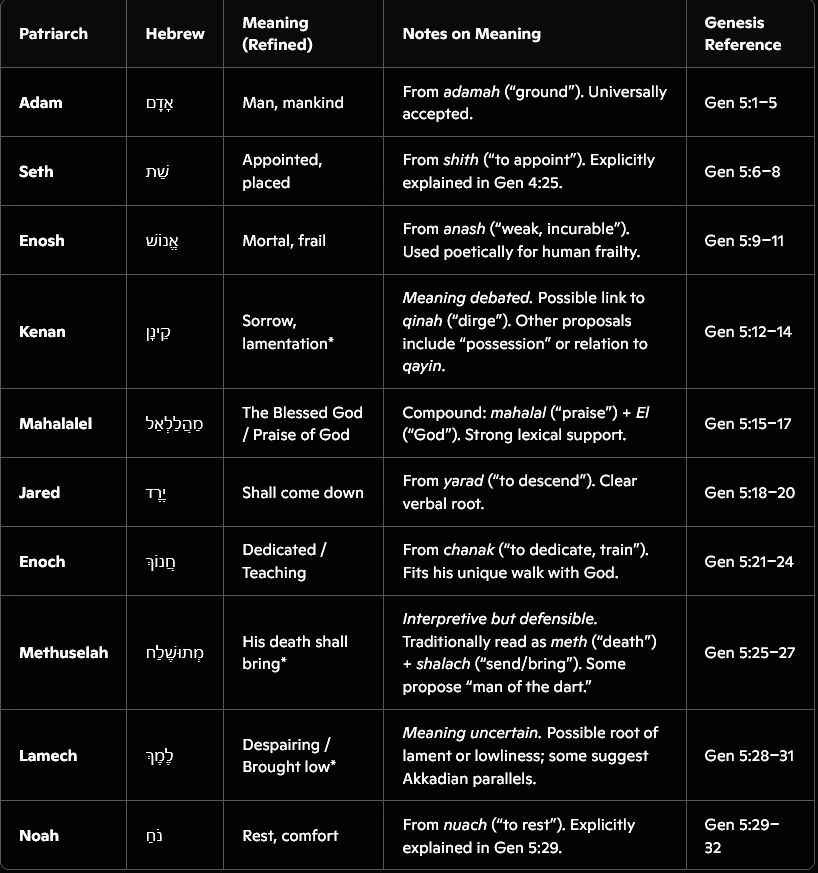
The Pierced YAHWEH
They Shall Look Upon Me
R25 APPENDIX
APPENDIX to R25: The Pierced Yahweh
The Climactic Testimony of Zechariah 12:10
________________________________
"...and they shall look upon me whom they have pierced, and they shall mourn for him, as one mourneth for his only son…”
— Zechariah 12:10
This is the line that shakes the heavens. The “Me” who is pierced. The “Him” who is mourned. The unity and distinction of the Godhead revealed in a single breath. The prophetic voice rises beyond titles and attributes, delivering a direct, first‑person identification that shatters every lesser view of Christ. This appendix stands as a decisive prophetic witness within Revelation #25, demonstrating that the deity of Christ is not a New Testament development, but an inevitability foretold in the Old Testament.
I. The Divine Speaker (The Identification)
The chapter opens with credentials that admit no rival:
"The burden of the word of the LORD for Israel, saith the LORD, which stretcheth forth the heavens, and layeth the foundation of the earth, and formeth the spirit of man within him." (Zechariah 12:1)
This is the voice of Yahweh Himself—the uncreated Creator, the One who spans the cosmos and breathes spirit into man. The Speaker is the Almighty.
II. The Divine Paradox (The Pierced One)
Then, in verse 10, this same Yahweh—eternal, invisible, Spirit—makes a declaration that demands incarnation:
"And I will pour upon the house of David, and upon the inhabitants of Jerusalem, the spirit of grace and of supplications: and they shall look upon me whom they have pierced, and they shall mourn for him, as one mourneth for his only son..." (Zechariah 12:10)
The Impossible Act: A spirit cannot be pierced- but, flesh and blood can. Scripture declares that such a body was deliberately fashioned for this very purpose:
“Wherefore when he cometh into the world, he saith, Sacrifice and offering thou wouldest not, but a body hast thou prepared me.”
— Hebrews 10:5
The Hebrew dāqār means to thrust through with violence—to penetrate flesh, to shed blood, to inflict a mortal wound.
The Inescapable Conclusion: For Yahweh to be pierced, Yahweh must take on flesh. The "Me" of the Old Testament must become the "Man" of the New.
This is the incarnation. It is crucifixion. It is the Creator entering His creation to be pierced by it.
III. The Mystery of the Godhead
Then comes the mystery that splits the heavens:
"...they shall look upon me [First Person] whom they have pierced, and they shall mourn for him [Third Person]..."
The prophecy reveals both unity of essence and distinction of persons within the Godhead. Yahweh is pierced—yet the mourning is for Another. The Speaker identifies Himself as the One pierced yet distinguishes Himself from the one pierced.
This is the Father, through the Spirit, bearing witness to the Son. Then comes the mystery that tears the veil of heaven itself: "...they shall look upon me [First Person] whom they have pierced, and they shall mourn for him [Third Person]..."
Here stands the Father, through the Spirit, bearing witness to the Son. It is the "Record" in its purest form: God sent His Son into the world to be pierced for our own iniquities—our sin.
IV. The Prophetic Testimony
Zechariah 12:10 does not stand alone. Composed centuries earlier the Spirit had already begun to prophecy of the Pierced One:
Psalm 22:16 — The Messiah's Cry from the Cross
“For dogs have compassed me: the assembly of the wicked have inclosed me: they pierced my hands and my feet.”
—Psalm 22:16
Penned by David, yet transcending David, this cry emerges from the lips of the Messiah Himself. The psalm begins with "My God, my God, why hast thou forsaken me?"—the very words Jesus would utter from Calvary. The piercing is not symbolic. It is anatomical. It is crucifixion, foretold a thousand years before crucifixion was known in Israel.
The Hebrew kā'ă·rî ("like a lion") has been contested by some, yet the ancient witnesses—the Septuagint, the Syriac Peshitta, and the Vulgate—all render it as "pierced." The textual verdict is clear: the hands and feet of the Messiah will be violently penetrated.
Isaiah 53:5 — The Suffering Servant Wounded
“But he was wounded for our transgressions, he was bruised for our iniquities: the chastisement of our peace was upon him; and with his stripes we are healed.”
—Isaiah 53:5
The Servant is not only pierced—He is punished, substituted, and slain. Though the voice is prophetic, the subject is unmistakably Yahweh. He bears the sins of many, is “cut off out of the land of the living” (v. 8), and yet “he shall prolong his days” (v. 10). The Servant is smitten by God—yet exalted by God. He is both the Offering—God giving His only Son—and the Offended—God laying upon that Son the iniquity of us all.
The Hebrew mᵊḥōlāl (“wounded, pierced through”) describes a blow that reaches the vital organs—a mortal wound, the kind that ends a life. Yet this death is no accident. It is deliberate. Ordained. Substitutionary.
“For he hath made him to be sin for us, who knew no sin; that we might be made the righteousness of God in him.”
— 2 Corinthians 5:21
V. The New Testament Fulfillment (The Record Sealed)
Both the Hour and Body prepared, Behold, the Man.
Centuries pass. The prophecies stand silent, waiting. Then comes the hour when heaven and earth converge at a Roman execution site.
John 19:34–37 — The Soldier's Spear
"34 But one of the soldiers with a spear pierced his side, and forthwith came there out blood and water. 35 And he that saw it bare record, and his record is true: and he knoweth that he saith true, that ye might believe. 36 For these things were done, that the scripture should be fulfilled, A bone of him shall not be broken. 37 And again another scripture saith, They shall look on him whom they pierced."
—John 19:34–37
John the Apostle—an eyewitness—stands at the foot of the cross and watches the spear enter the side of Jesus. In that moment, under the inspiration of the Holy Spirit, he recognizes what he is seeing: the fulfillment of Zechariah 12:10. The Greek exekéntēsan ("they pierced") is the Septuagint's exact rendering of the Hebrew dāqār.
The "Me" whom Yahweh said would be pierced is the "Him" hanging on the tree.
Revelation 1:7 — The Coming King
"Behold, he cometh with clouds; and every eye shall see him, and they also which pierced him: and all kindreds of the earth shall wail because of him. Even so, Amen."
—Revelation 1:7
The final book of Scripture returns to Zechariah's prophecy and declares its universal scope. The Pierced One will be seen. The invisible God will be visible. Every nation will look upon the wounds—and every knee will bow.
Zechariah 12 is the death-blow to every heresy that would diminish the glory of Christ. It presents a divine paradox that can only be resolved at Calvary:
The Infinite becomes Finite: The One who "stretcheth forth the heavens" is the One who is pierced in time and space.
The Invisible becomes Visible: The Yahweh whom "no man hath seen at any time" becomes the One upon whom they shall look upon.
The Immortal becomes Mortal: The Eternal Spirit takes on a "prepared body" (Hebrews 10:5) to be smitten as the "man that is my fellow" (Zechariah 13:7).
VI. Jesus: The Passion in his Piercing
If you have ever wondered whether God sees you—look to the One who was pierced.
If you have ever questioned whether God would come for you—look to the One who was pierced.
If you have ever doubted whether your sins could be forgiven—look to the One who was pierced.
The hands that stretched out the heavens are the same hands that were stretched on a Roman cross. The side that was opened by a Roman spear was opened to make a way for you. The eyes that will one day be seen by all were once closed in death—so yours could be opened to life.
"Behold, he cometh with clouds; and every eye shall see him, and they also which pierced him: and all kindreds of the earth shall wail because of him. Even so, Amen." — Revelation 1:7